
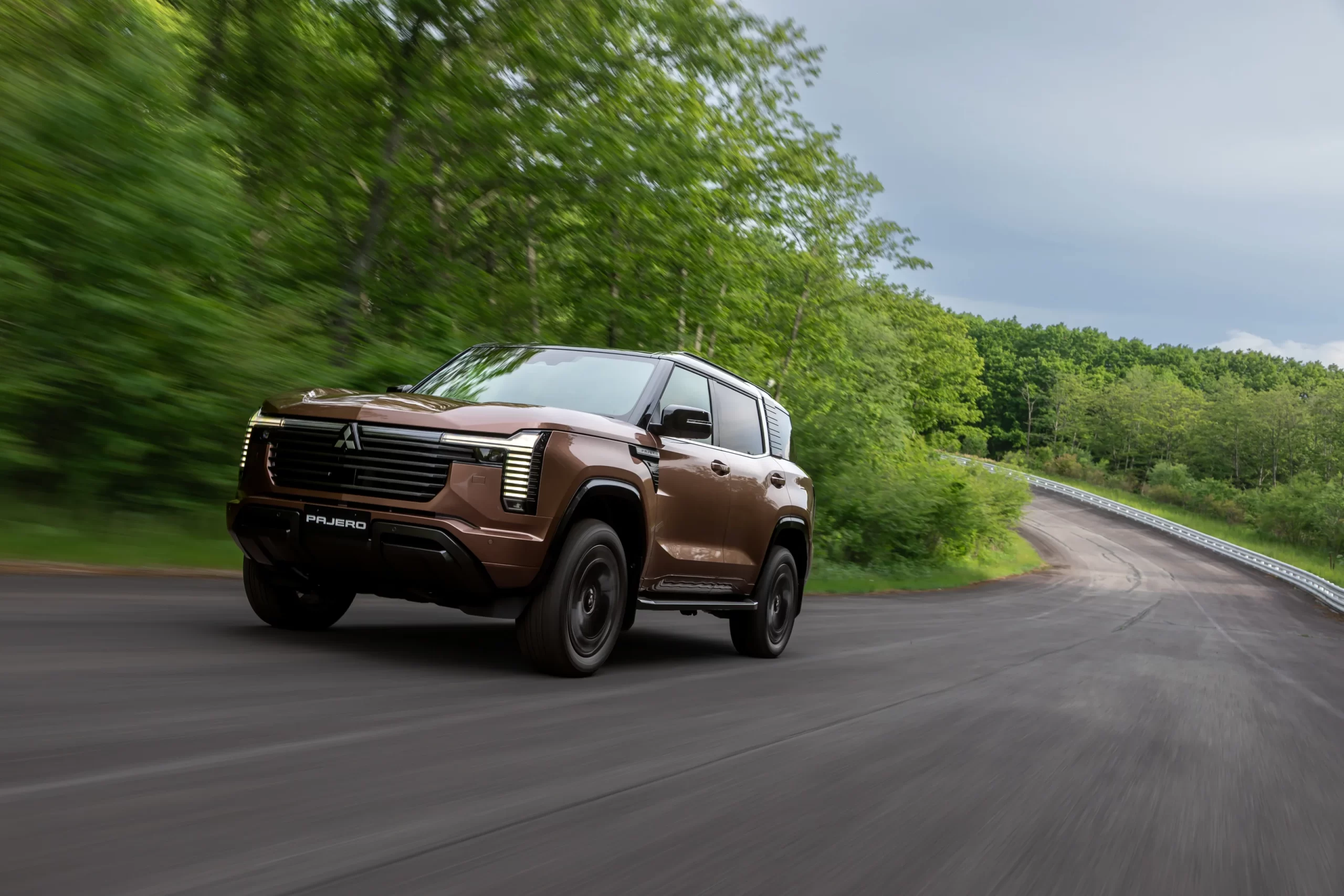
The revived Mitsubishi Pajero has already been officially shown, but Russian buyers will have to wait for the left-hand drive version. For now, the SUV is produced only with right-hand drive, and the transition to left-hand drive modifications is not expected before mid-2027. At the same time, the new Pajero retained the frame structure, received a 2.4 liter diesel engine and a full seven-seater interior.
Mitsubishi Pajero returns after a five-year hiatus

The new, already fifth generation Mitsubishi Pajero was presented on September 2, 2026 in Thailand. Production of the car was also organized there. The model’s return comes five years after the previous Pajero was discontinued.

Mitsubishi, however, chose a rather unusual strategy for the new model. The company decided not to turn the Pajero into a typical urban crossover, completely abandoning its off-road capabilities. Instead, the vehicle retained its frame structure and all-wheel drive, but received a modern interior and an expanded set of electronic systems.
Initially, production is focused on right-hand drive markets. Sales of the new Pajero are expected to begin in Thailand by the end of 2026, after which the model will be released in Japan and Australia. In the future, the sales geography should expand to approximately 100 countries.

Why Russia will have to wait for a left-hand drive Pajero
It is fundamentally important for the Russian market that the current Pajero is produced only with right-hand drive.
As Nikolai Ivanov, Director of the New Car Sales Department, explained, production of this version will continue until mid-2027. After that, left-hand drive modifications are expected to appear.

This moment may become the starting point for the full-fledged release of the model on the Russian market. A right-hand drive car can be imported through alternative channels, but for most Russian buyers this configuration remains a compromise.
Furthermore, importing a right-hand drive Pajero does not solve the main issue – the cost of the car. When delivered from Thailand, the final price is affected not only by the factory cost, but also by logistics, import payments and recycling fees.

The new Pajero has retained the main feature of the old models
One of the main differences between the new Mitsubishi Pajero and many modern SUVs is its design.
The car has retained its frame architecture, and the Super Select 4WD-II all-wheel drive system is responsible for traction distribution. In combination with it, the S-AWC system is used, which controls traction and helps the car maintain stability in various road conditions.

This is a particularly interesting combination for Russia. Most new models on the market today focus primarily on comfort and fuel efficiency, while the Pajero remains focused on off-road use.
At the same time, the SUV has received modern electronics and no longer looks like an old-school utilitarian vehicle.
2.4-liter diesel and automatic instead of experimenting with the powertrain
Under the hood of the new Pajero is a 2.4-liter turbodiesel. Its output is 204 hp and the maximum torque is 480 Nm.
The engine is paired with an eight-speed automatic transmission.

For a large frame SUV, this combination makes perfect sense. High torque ensures confident traction when the vehicle is fully loaded, towing a trailer, and driving on difficult surfaces.
At the same time, the 204-horsepower engine may be one of the factors that will influence the price of the car in Russia. For an imported car, not only power is important, but also engine displacement, since the payments associated with it can significantly change the final price.
Seven seats are another argument in favor of the Pajero
The dimensions of the new Mitsubishi Pajero correspond to a large SUV: the length of the car reaches 4920 mm, the wheelbase is 2870 mm, and the ground clearance is 230 mm.
But for potential Russian buyers, another parameter is no less important – the cabin is designed for seven people.
The third row turns the Pajero from just a large SUV into a family car for long trips. When fully loaded, the requirements for traction, spaciousness and all-wheel drive capabilities become especially relevant.

It is the combination of seven seats, a diesel engine and a frame structure that distinguishes the new Pajero from the large number of crossovers that are offered on the market today.
The interior has become much more modern
While maintaining the classic off-road architecture, the interior of the new Pajero has noticeably departed from the previous concept.
Depending on the version, the car received two large 14.3-inch screens, a digital instrument cluster and modern driver assistance systems. Various interface design options are available, including styling reminiscent of classic Pajero models.
Thus, Mitsubishi has attempted to combine two different approaches: the mechanical foundation of a traditional SUV and the digital equipment of a modern car.
For a potential buyer, this means that the new Pajero is designed not only for use outside the city. It should also remain comfortable for daily trips.
What could prevent Pajero from becoming popular in Russia
The main problem with the new Mitsubishi Pajero for the Russian market is not yet related to either the engine or its cross-country ability.
It’s the price.
Even after the appearance of the left-hand drive version, the final cost of the car will depend on many variables. In addition to the price of the SUV itself, you’ll need to factor in transportation from Thailand, the exchange rate, import duties, recycling fees, and dealer fees.
Therefore, comparing the future Russian Pajero price tag solely with its price on the Thai market would be inaccurate.
Furthermore, buyers will need to consider the availability of spare parts and service infrastructure. The model’s return to the global market doesn’t automatically mean a wide dealer network will appear in Russia.
When might the new Pajero appear in Russian dealerships?
For now, the most important target date remains mid-2027. It is then that Mitsubishi plans to switch to the production of left-hand drive versions.
Until then, Russian motorists may encounter mainly right-hand drive vehicles imported from countries where this configuration is standard.
After the appearance of the left-hand drive Pajero, the situation may change. But it will be possible to definitively talk about the model’s prospects in Russia only after the trim levels, prices and delivery terms become known.
The revived Pajero relies on a traditional recipe
The new Mitsubishi Pajero turned out to be an interesting combination of old and new approaches. On the one hand, it has a frame construction, a diesel engine, high ground clearance and an all-wheel drive system. On the other hand, there is a digital instrument panel, large screens and modern electronic assistants.
For the Russian market, three characteristics may be especially important – left-hand drive, seven seats and the final price
The first two points should be resolved after the start of production of left-hand drive cars in 2027. But the price remains the main unknown. It will show how easily the new Pajero will be able to compete for the Russian buyer with other large SUVs and imported SUVs.