

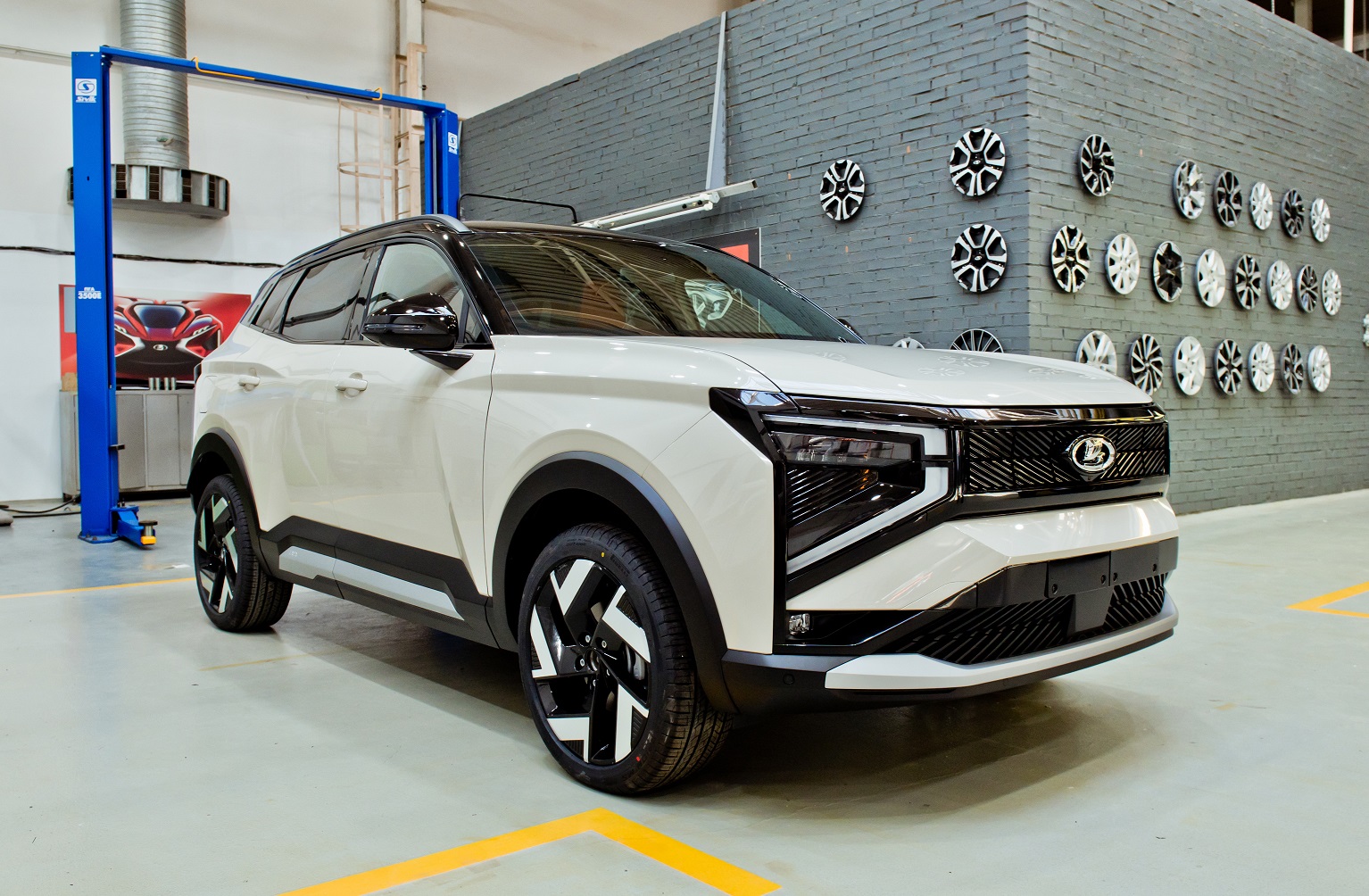
Lada Azimut is entering the market with front-wheel drive, and the lack of an all-wheel drive version has already become a subject of discussion among potential buyers. However, for the new Russian crossover, this does not necessarily mean a weak point. In most everyday scenarios, the front-wheel drive configuration can prove more practical and cheaper to operate. This is reported by Rossiyskaya Gazeta.
Serial production of the Lada Azimut started on September 25, 2026 in Tolyatti. At the first stage, the crossover will receive two engines – a 1.6-liter with a capacity of 120 hp with a six-speed manual transmission and a 1.8-liter with 132 hp in combination with a CVT.
Moreover, one of the features of the model will be the front-wheel drive. For a car that is positioned as an urban crossover, this solution seems quite logical, although it limits the car’s capabilities off the asphalt.
Where all-wheel drive is really necessary
The very word “crossover” often creates the impression in buyers that a car must have four-wheel drive. In practice, this is not the case.
All-wheel drive is especially useful where the car regularly encounters deep snow, mud, wet ground, steep climbs or poor roads. For hunting, fishing, on bumpy country roads or in regions with heavy snow, the advantages of such a transmission are obvious.
But the typical scenario for using an urban crossover is completely different. This includes asphalt, courtyards, parking lots, country roads and the occasional trip to the dacha on a dirt road.
In such conditions, ground clearance, the right tires, the operation of the electronic stability control system and traction control system are much more important. Front-wheel drive doesn’t turn a car into an SUV, but it’s also capable of handling regular winter and country roads.
What does front-wheel drive offer an Azimut owner?
The front-wheel drive transmission has several very specific advantages.
Firstly, the vehicle’s design is simpler than that of an all-wheel drive version. It doesn’t require a propeller shaft, rear axle, or some additional transmission components. This potentially reduces the vehicle’s weight and the number of components that require maintenance.
Secondly, the front-wheel drive configuration is generally well suited for city driving. Under normal conditions, the traction wheels are under engine load, and the vehicle itself doesn’t require the constant operation of an additional axle.
Thirdly, front-wheel drive keeps the cost of the vehicle lower than that of a comparable all-wheel drive version. This is especially important for Azimut: the model must compete not only on its performance characteristics, but also on its final purchase price.
At the same time, skimping on the transmission doesn’t mean the car can be considered a full-fledged SUV replacement. If the owner regularly drives through deep snow or on difficult off-road terrain, the lack of all-wheel drive will become an objective limitation.
Winter operation will depend on more than just the drivetrain.
In winter, the difference between front-wheel drive and all-wheel drive is especially noticeable when starting off on slippery surfaces. However, there is an important nuance here: all-wheel drive primarily helps transfer traction, but does not cancel the laws of physics during braking.
Therefore, the quality of winter tires will be of great importance to Azimut owners. A good set of tires can significantly improve the performance of a front-wheel drive vehicle on snow and ice.
Stability and traction control systems can also help with acceleration on slippery roads. However, electronics alone cannot turn a front-wheel drive crossover into a vehicle for severe off-roading.
That is why potential Azimut owners should consider not only the presence of all-wheel drive in the technical specifications, but also their own driving route.
Equipment may be more important than drive
The Lada Azimut is designed as a more modern crossover than the brand’s traditional models. The declared equipment includes a digital instrument panel, a 10-inch multimedia system screen, wireless charging, dual-zone climate control, a panoramic roof, and a 360-degree camera.
Heated side windows deserve special attention. This is a fairly specific solution for the Russian market, but it makes practical sense in winter: it can facilitate the removal of ice and improve visibility in cold weather.
A digital ecosystem with a voice assistant is also included. The driver will be able to control some of the car’s functions through voice commands, including navigation, calls, music, and some driving settings.
It’s an interesting compromise: instead of trying to make the Azimut a versatile SUV, AvtoVAZ is focusing on the features and comfort of an urban crossover.
Why the lack of all-wheel drive may even be an advantage
For a buyer who drives 90% of the time in the city, all-wheel drive is far from always a must-have. An additional transmission is needed primarily when the owner really uses its capabilities.
The front-wheel drive Azimut potentially has another advantage – a more reasonable cost of ownership. Fewer transmission components mean fewer potential service points, while the lack of rear-wheel drive reduces the vehicle’s complexity.
The main question, therefore, is not whether the Azimut can compete with all-wheel drive crossovers off-road. It will obviously have its limitations in such a comparison.
What’s much more important is whether Lada can offer, at a reasonable price, sufficient ground clearance, good body geometry, modern electronic systems, and comfort so that city buyers truly don’t need all-wheel drive.
Azimut has another argument for the future.
At the same time, the current configuration won’t necessarily be the final one. AvtoVAZ previously announced it was working on a version of the Azimut with a turbocharged engine producing around 150 hp and a classic automatic transmission.
Thus, the model’s lineup may expand over time. If demand for the crossover proves high enough, the manufacturer will have the opportunity to tailor it to different buyer groups.
At launch, the Azimut appears primarily as an urban family crossover. And it’s precisely in this role that front-wheel drive shouldn’t automatically be considered a disadvantage. For a buyer who needs a car for the city, highway and light country trips, price, fuel consumption, ground clearance, equipment, reliability of the power plant and maintenance costs will be much more important.
But those who regularly drive on deep snow, mud and difficult dirt roads should wait for a more suitable modification or immediately consider a car with a full drive.
Views: