
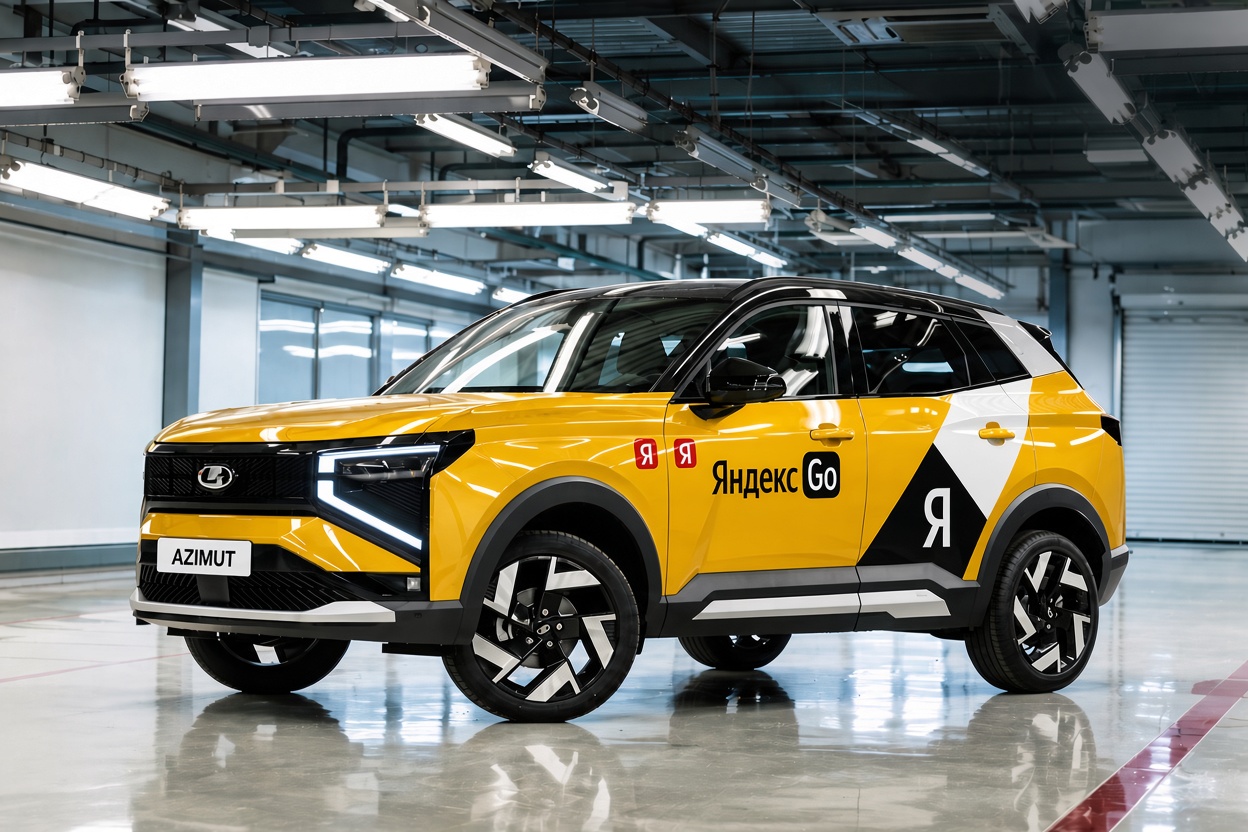
AvtoVAZ is considering the new Lada Azimut crossover as a vehicle for the Russian taxi market. Serial production of the model began on September 25, 2026, and the first cars are expected to arrive at dealerships by the end of the year. The company hopes that, thanks to the high degree of localization, the crossover will be included in the list of vehicles approved for use as taxis.
AvtoVAZ’s press service confirmed to Rossiyskaya Gazeta that the manufacturer is interested in this scenario. The company emphasized that the Azimut is viewed precisely as a highly localized domestic vehicle.
Why the taxi market is important for Azimut
The prospect of using the new crossover as a taxi is important for more than just additional sales. Corporate fleets and taxi services can provide a significant volume of sales for this model even during its initial market presence.
Taxi vehicles are used significantly more intensively than regular private cars. Therefore, their use allows for a more rapid assessment of the actual service life of the engine, transmission, suspension, and other components. For the manufacturer, this simultaneously increases sales and provides a wealth of operational data.
Localization is particularly important. Since March 1, 2026, a law has been in effect in Russia establishing localization requirements for vehicles used in taxis. The Ministry of Industry and Trade is compiling a list of eligible models, which may be updated as new vehicles that meet the established criteria become available.
The list currently includes 36 models. If the Lada Azimut meets the requirements, its inclusion will allow the crossover to be used in the regulated transportation segment under the conditions established by law.
Why might the Lada Azimut be of interest to taxi companies?
The new crossover is initially attractive for commercial use for several reasons. These include a more spacious body compared to sedans and the option to get a car with an automated transmission.
At launch, the Azimut should receive upgraded VAZ engines with a capacity of 1.6 and 1.8 liters. Their declared power is 120 and 132 hp, respectively. The transmission lineup includes a six-speed manual gearbox, as well as a continuously variable transmission.
For taxis, the availability of a version that does not require constant use of a manual gearbox may be a fundamental factor. This is especially relevant for vehicles that are operated several shifts per day.
In the future, AvtoVAZ is also considering other powertrain options. The company is testing the Azimut with a turbocharged engine, and at the same time, information has emerged about the development of a hybrid version. In addition, a six-speed automatic transmission is expected in the future.
When will the Lada Azimut hit the roads?
Serial production of the crossover already began on September 25. However, the start of production and the beginning of mass sales are different stages: after the release of the first cars, it is necessary to build up inventory and prepare the cars for delivery to dealerships.
AvtoVAZ expects to bring the Azimut to market by the end of 2026. Thus, the first actual deliveries to private buyers and corporate clients may begin even before the end of the year.
If the model is subsequently approved for use as a taxi, its prospects will depend not only on its specifications, but also on the final price, maintenance costs, availability of spare parts, and the lifespan of the powertrain.
The main question is price and cost of ownership
For a private buyer, design and equipment may be of great importance, but for a taxi fleet, the economics of a car are different. Here, the total cost of ownership is more important: acquisition price, fuel consumption, service intervals, repair costs, gearbox lifespan, and availability of body parts.
Therefore, the potential inclusion of the Lada Azimut in the list of cars for taxis does not in itself mean a mass transition of carriers to this model. For businesses, the decisive factor will be how profitable the vehicle is in daily commercial use.
Nevertheless, AvtoVAZ’s very interest in this segment shows that the manufacturer expects to use the Azimut not only as a family crossover for private buyers. If the launch is successful, the model may receive an additional sales channel through corporate fleets and taxi services.