
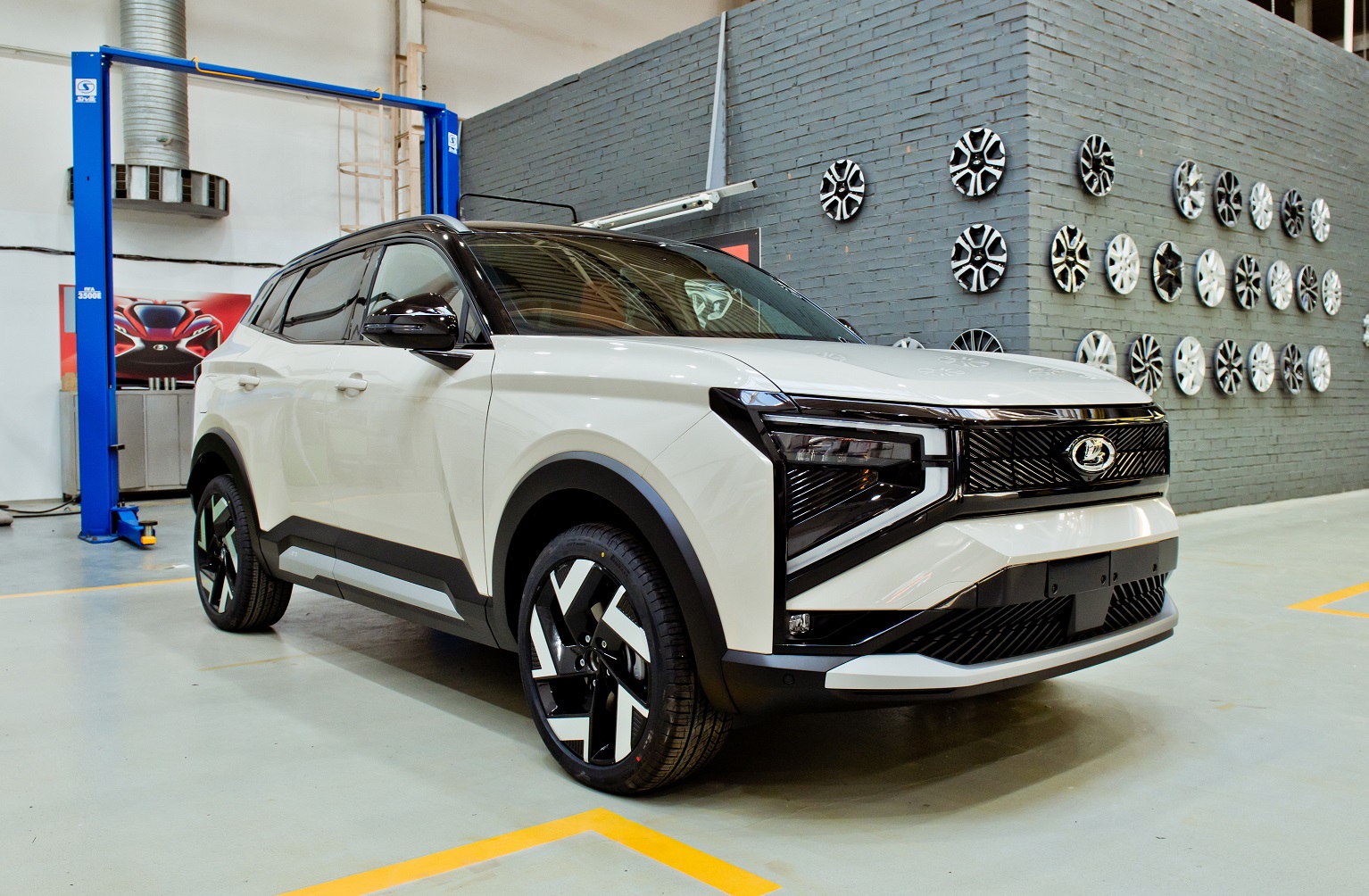
AvtoVAZ continues to prepare the new Lada Azimut crossover for serial production and has revealed details of the factory body tests. In one of the tests, the vehicle’s power structure was subjected to a load of up to 10 tons. To understand the scale, the company compared this force with the weight of six to seven regular passenger cars, or approximately two adult African elephants.
At first glance, the figure looks impressive, but the 10-ton load itself does not yet indicate how safe or reliable the vehicle will be in real-life operation. Much more important is how the body withstands the impact, how well it maintains its geometry, and how its power elements behave after the test.
The Lada Azimut body was tested with a load of up to 10 tons
During the test, AvtoVAZ specialists used a special loading element. It impacted the door area and penetrated the structure by approximately 46 cm.
The purpose of this test is to verify the body’s ability to withstand significant localized loads. In a real-world accident, the impact on the vehicle is not always distributed evenly across the entire body. Therefore, such tests allow us to evaluate the performance of individual areas of the vehicle’s structural integrity.
The factory notes that the test places significant loads on the body and allows us to evaluate its strength and ability to maintain its specified geometry.
It is this last parameter that is particularly important. The body of a modern car is more than just a shell on which the engine, suspension, and interior are mounted. This is a complex supporting structure, the precision of which determines the vehicle’s rigidity, door and window performance, opening geometry, and body behavior under various loads.
Why “10 tons” can’t be directly compared to a crash test
The impressive figure of 10 tons can easily create the impression that the Lada Azimut has passed a comprehensive safety test. However, these are different things.
Body strength testing and a comprehensive crash test pursue different objectives. When testing localized loads, specialists evaluate how well the structure resists impact and maintains its designed shape. The crash test evaluates a range of parameters: body deformation during a collision, the operation of programmable crumple zones, maintaining interior space, element movement, and occupant protection.
Therefore, it is more accurate to view the Azimut factory test as one of the design verification stages, rather than as a replacement for independent safety testing.
New production tooling was created for Azimut
Body testing is only part of the extensive preparation of the Lada Azimut for production. Previously, AvtoVAZ announced the use of laser welding in the manufacture of the new crossover’s body.
The model also required large-scale tooling for the production of body parts and plastic elements. The company noted that this was the largest tooling of this type in the entire history of the plant.
This is significant from the point of view of the project itself. The Azimut is not being developed as yet another minor upgrade to an existing model, but as a new crossover for Lada, for which production processes had to be adapted.
What does the test mean for future owners?
For the buyer, such information is important primarily as an indication that the Lada Azimut body undergoes not only standard production checks, but also special load-resistance tests.
However, drawing conclusions about the vehicle’s safety solely based on the 10-ton load rating would be incorrect. An objective assessment will require the results of a more extensive set of tests, including data from independent organizations, if available.
Nevertheless, the testing technology itself is interesting. The more complex the body structure and the more new solutions it has, the more important it is to test not only individual welded joints, but also the performance of the entire power structure.
Lada Azimut reaches a new level for AvtoVAZ
The introduction of laser welding, large production equipment and additional body tests shows how seriously the plant is approaching the launch of Azimut.
For the Russian buyer, there is another important point here: the reliability of the new crossover will be determined not by one spectacular characteristic, but by a combination of factors – body rigidity, welding quality, suspension life, power units, electronics and availability of repairs.
Therefore, the 10-ton load test should not be perceived as an advertising record, but as one of the elements of a large program for testing the new Lada Azimut before serial production release.