

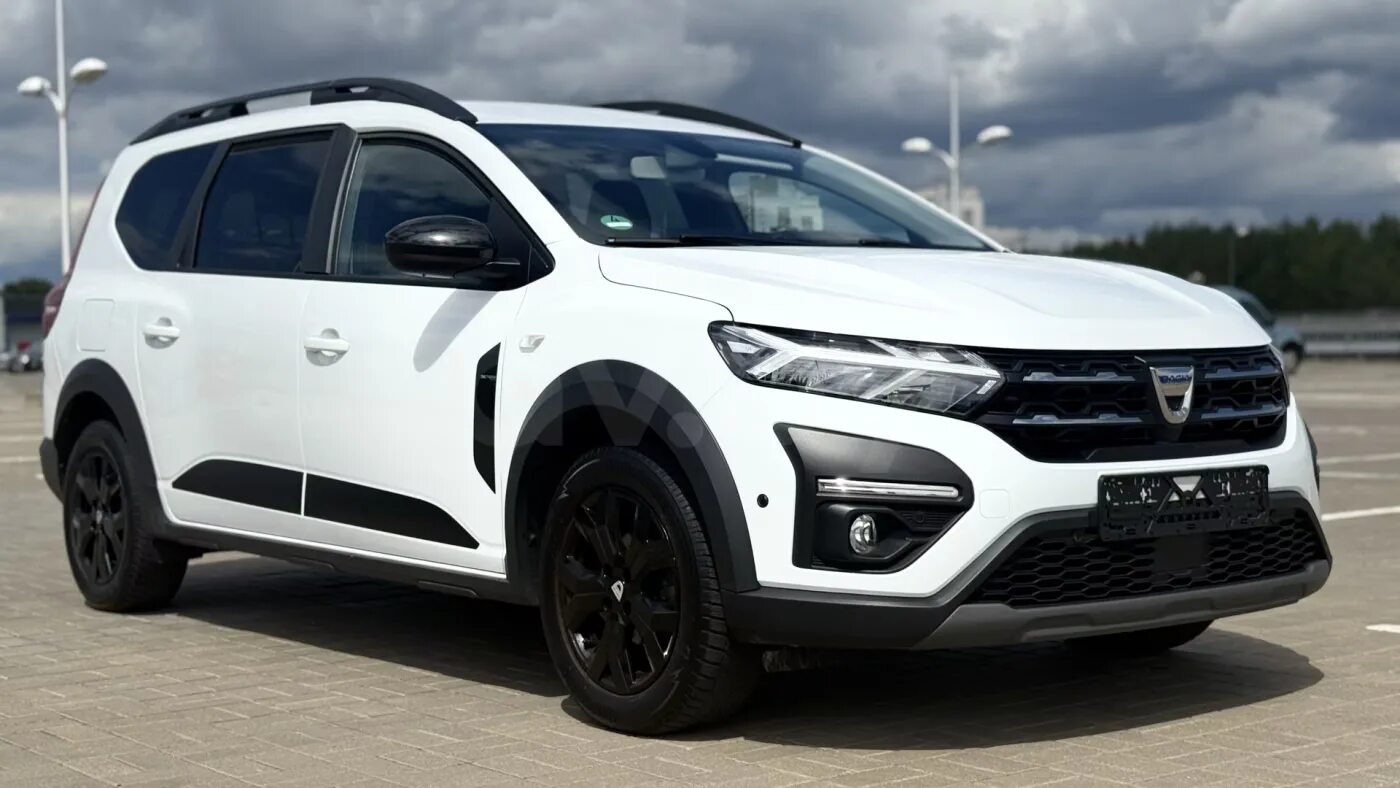
The history of the Lada Largus could have developed completely differently. The Russian station wagon, which is still in demand due to its spaciousness and relatively simple design, could well have received a new generation on a modern Renault platform. But after the French concern left Russia, plans for the development of the AvtoVAZ model range changed.
You can take a look at one of the possible versions of the future Largus thanks to the Dacia Jogger. This car from the Romanian brand, part of the Renault Group, combines the spaciousness of a minivan, the practicality of a station wagon and the increased ground clearance of a crossover. Moreover, it has long existed not as a concept, but as a production model.
The Jogger has seven seats, a trunk volume of up to 708 liters, ground clearance of about 200 mm and even a hybrid powertrain. For comparison, the current Largus offers a much more conservative technical concept.
Why is the Dacia Jogger comparable to the Largus
The Dacia Jogger was released in 2021. When developing this model, the manufacturer decided to combine the advantages of two different car classes. On the one hand, it is a large family station wagon, on the other, a practical compact van with the option of installing a third row of seats.
The model replaced the Logan MCV and Lodgy. Essentially, Dacia offered buyers one car instead of two, focusing on spaciousness and functionality.
The similarities with the Largus are obvious here. The Russian model was also not created for the sake of spectacular design or sporty characteristics. Its main task is to transport people and things, providing a relatively affordable cost of operation.
But there is a fundamental difference. Largus technically goes back to the previous generation of Renault Logan and the B0 platform, while Jogger uses a more modern CMF-B architecture.
This is what makes the Romanian station wagon especially interesting for the Russian market. Previously, Renault considered transferring future Lada models to modern platform solutions. Therefore, the appearance of a car with the CMF-B architecture as the next stage of Largus development seems to be a completely logical scenario.
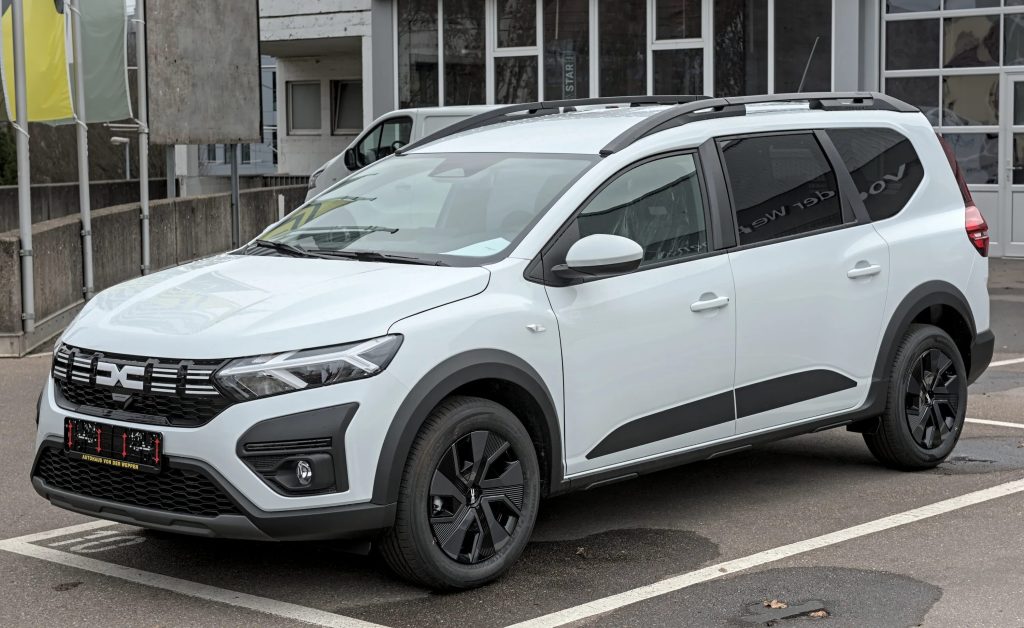
Almost 4.55 meters in length and three rows of seats
Dacia Jogger cannot be called a small car. Its length is 4547 mm, width – 1784 mm, height – 1674 mm. The wheelbase reaches 2897 mm.
These parameters allow for a fairly spacious interior and a full-fledged layout with three rows of seats.
Buyers have two configurations available: five-seater and seven-seater. This is an important advantage for those who do not want to purchase a large minivan, but occasionally need additional passenger seats.
The luggage compartment also deserves attention. In the five-seater version, its volume reaches 708 liters. If you fold the seats down and use the car to transport large cargo, the space increases to 1819 liters.
When using all seven seats, the free space for luggage becomes noticeably smaller. This is a natural compromise for any seven-seater car: the third row has to be paid for by reducing the cargo compartment.
A similar transformation would be quite in demand for Largus. For example, on weekdays the car can be used as a regular family station wagon, and during trips or travels, additional seats can be used.
Clearance 200 mm: a station wagon that is not afraid of bad roads
A separate feature of the Jogger is increased ground clearance. Its declared value is about 200 mm.
For an ordinary family station wagon, this is a very decent figure. It is especially relevant when driving on dirt roads, broken asphalt and areas with deep ruts.
Externally, the car also resembles a crossover. Plastic protective pads along the perimeter of the body, increased ground clearance and characteristic proportions make it noticeably less like a classic station wagon.
After the update, the Jogger received a modified front end, new lighting equipment and redesigned decorative elements. As a result, the car looks more modern and expressive than its Russian counterpart.
However, there is an important nuance: despite the crossover appearance and high ground clearance, the Dacia Jogger remains a front-wheel drive car. There is no all-wheel drive in the lineup. Therefore, its off-road capabilities are limited mainly by geometric cross-country ability and ground clearance.
Turbo engines and a hybrid instead of the usual naturally aspirated engine
The most serious difference in the potential successor to Largus could appear under the hood.
Dacia offers several powertrain options designed for different operating scenarios.
Petrol TCe 110. Turbocharged engine with a capacity of 110 hp. works in tandem with a six-speed manual transmission. This option is suitable for those who need a relatively simple configuration without a complex hybrid system.
Gasoline-petrol ECO-G 120. The 120 hp engine can use gasoline and liquefied gas. This version is especially interesting in terms of fuel costs, especially with high annual mileage.
Hybrid Hybrid 155. The most technologically advanced modification develops a total power of 155 hp and is equipped with an automatic transmission. The hybrid system is focused, among other things, on urban use, where the ability to move with the participation of an electric motor allows for more efficient fuel consumption.
For the Russian market, such a line could become a serious advantage. Largus buyers now have to make do with a much more limited choice of engines and transmissions.
But there’s a downside. Turbocharged engines and hybrid systems potentially increase repair costs and impose higher maintenance requirements. For a commercial vehicle that covers long distances every day, this is especially important.
Therefore, the ideal scenario for the new Largus could be not just installing the most modern engine, but also maintaining the available naturally aspirated versions along with more technologically advanced modifications.
What would appear in the interior of the new Largus
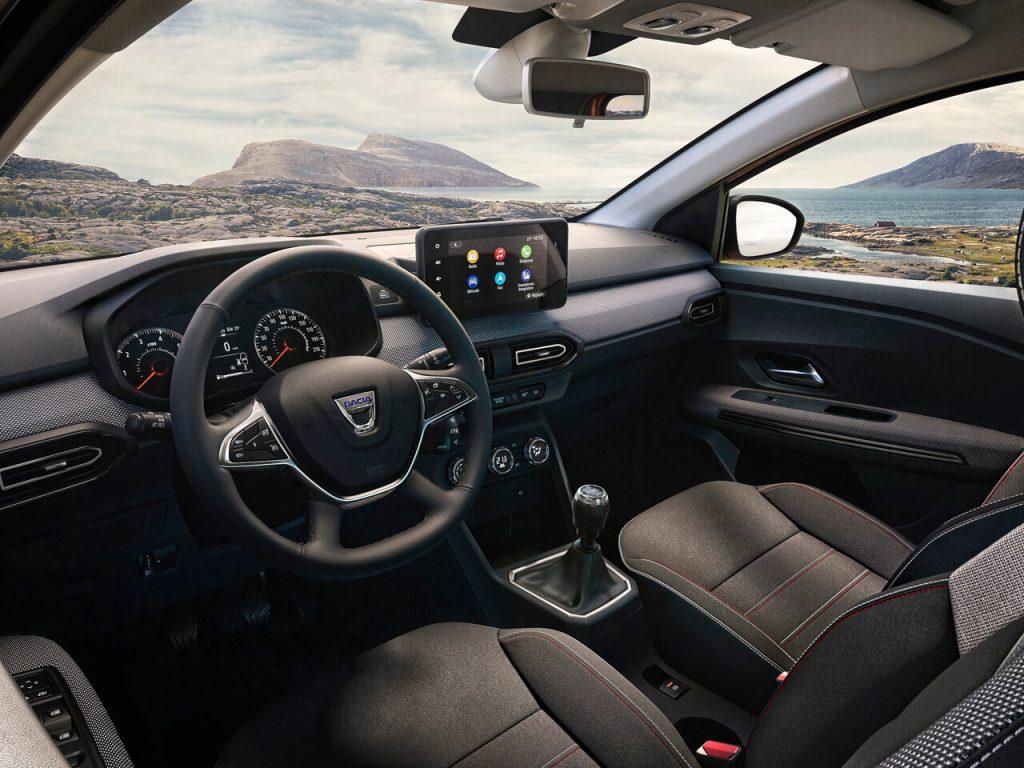
The interior of the Jogger also shows how much the requirements for affordable family cars have changed.
Depending on the configuration, the model is equipped with a digital instrument panel, a multimedia system with a 10-inch screen, cameras and electronic driver assistants.
For owners of the current Largus, such equipment would be a noticeable step forward. In the Russian station wagon, the main emphasis is still placed on functionality, and not on modern digital capabilities.
At the same time, Dacia adheres to a fairly rational philosophy. The Jogger doesn’t attempt to compete with expensive premium cars. It uses practical materials, a clear interior architecture, and solutions designed to facilitate everyday use.
This approach could be a good fit for Lada. A buyer of a large family station wagon does not necessarily need an expensive interior, but modern multimedia, convenient ergonomics and up-to-date safety systems do matter.
How much does a station wagon cost that could replace Largus
On the Romanian market, the cost of the updated Dacia Jogger is approximately 19-28 thousand euros, depending on the configuration and engine.
Converted to rubles, this is approximately 1.91-2.81 million rubles according to the price benchmark used.
The Russian Largus is noticeably more affordable: a regular station wagon is estimated at approximately 1.6-1.9 million rubles, and the Cross version is approaching 2 million rubles.
It turns out that even in Europe, the Jogger is in a higher price category. At the same time, it offers a different technical basis, a wider choice of power plants and modern equipment.
However, it would be wrong to conclude that the Russian new generation Largus would necessarily cost 2.5-3 million rubles. With localization of production, adaptation of trim levels and the use of Russian suppliers, the price could differ from the European one.
On the other hand, without localization, such a car could hardly claim the role of a mass-market affordable station wagon. Import deliveries, customs duties and logistics would inevitably affect the final cost.
Why the Russian market lacks such cars
The history of the Dacia Jogger shows an interesting trend: even with the popularity of crossovers, there remains a demand for practical cars with a large interior.
Not every family needs an SUV with all-wheel drive. For many, a roomy trunk, the ability to transport five to seven people, and comfortable seating are much more important.
In this regard, the Jogger concept seems particularly rational. It offers the functionality of a minivan, but does not require the owner to move up to the more expensive segment of large family cars.
For the Russian market, such a model could occupy an interesting niche between the Largus, compact crossovers, and imported minivans.
Such a car could be especially in demand among families with children, travelers, and small businesses. However, for the latter category of buyers, simplicity of design, availability of spare parts, and repair costs are still important.
What’s the bottom line?
The Dacia Jogger is not a new Largus and not an official replacement for the Russian station wagon. But this is a clear example of how a familiar automobile concept could have developed with continued cooperation between Renault and AvtoVAZ.
Instead of a car with a long-familiar technical basis, the Russian market could potentially have received a modern station wagon on the CMF-B platform, with seven seats, a trunk of up to 708 liters, ground clearance of about 200 mm and a hybrid powertrain.
And the most interesting thing: this did not require inventing an entirely new class of car. It was enough to continue developing the existing Largus concept, adapting it to modern customer requirements.