
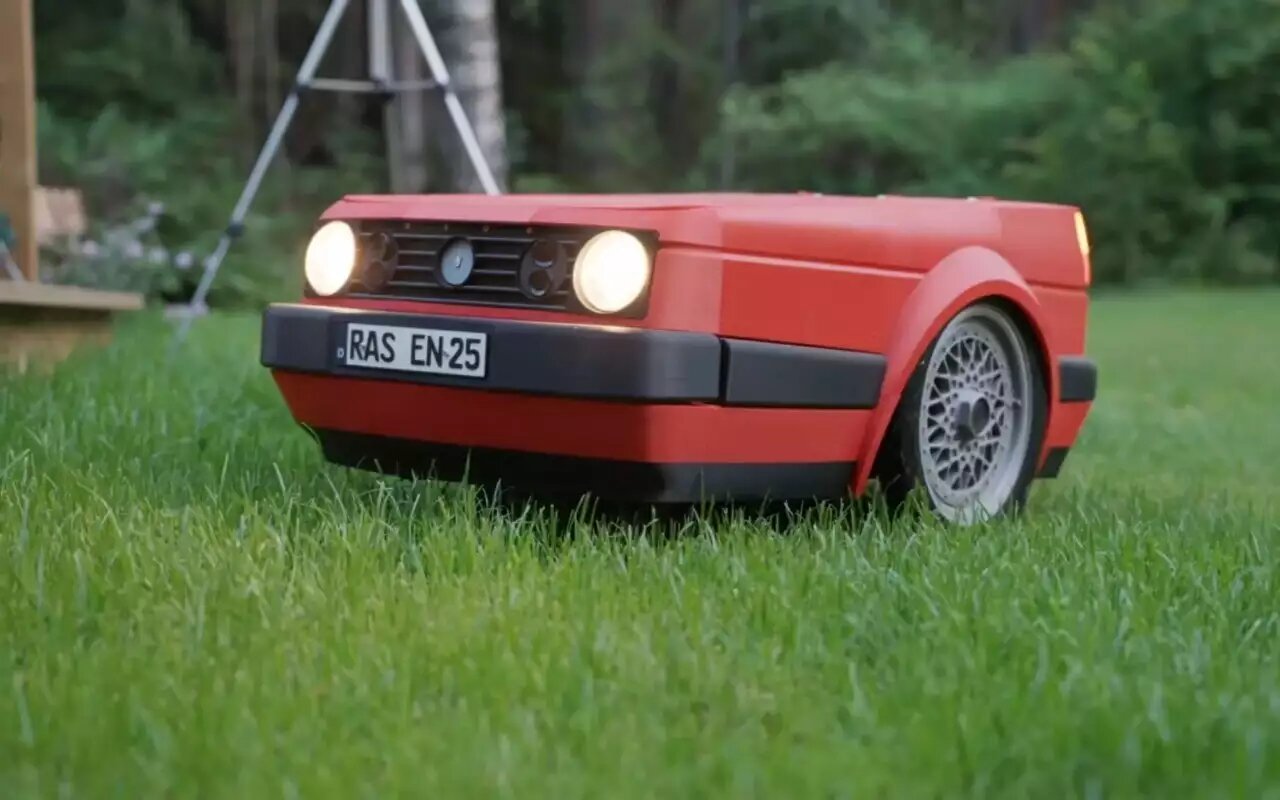
What do you get if you take the iconic Volkswagen Golf II GTI, shrink it down several times, and move it from the road to the lawn? German blogger Nils from Project Hunter has shown the answer — an unusual autonomous lawn mower styled like the legendary hot hatchback.
At first glance, this is a toy Golf GTI. But under the plastic body lies a very serious robotic platform that can move independently across the lawn, detect obstacles, and even respond to small animals.
A Golf GTI that chose the lawn over the road
The project didn’t come about by chance. Nils based the exterior on the second-generation Volkswagen Golf, since this is the kind of car his father once owned.
The body of the homemade lawn mower was made on a 3D printer. It took over 100 hours to print the body elements alone. The designer didn’t limit himself to the car’s silhouette, however: the miniature Golf features round headlights, a black grille, sport bumpers, flared wheel arches, BBS-style wheels, and working taillights.
The design is three-wheeled. The decorative body houses an aluminum frame that houses the battery, electronics, sensors, and cutting mechanism.
So, this isn’t just a big toy with motors. Essentially, Nils has built a compact, self-contained vehicle, with the car design being just the outer shell.
Under the hood is a drone motor and an adjustable blade.
The most unusual part of the design is hidden under the opening hood. The cutting mechanism is mounted there, driven by a brushless electric motor from the drone.
The motor rotates the cutting disc via a threaded rod and a pair of bearings. Its height can be adjusted, so the author was able to change the cutting height of the grass.
This solution is interesting above all because of its compactness. A robotic lawn mower does not need a heavy gasoline engine: the electric drive provides sufficient blade rotation speed, and the battery simultaneously powers the chassis and electronics.
Serial robots use a similar philosophy – a compact electric drive, battery, automatic control and constant lawn maintenance instead of rare mowing in large volumes.
The most interesting thing is the safety system
The main feature of the project is not the appearance of the Golf, but how seriously the author approached autonomous movement.
The mini-machine is equipped with four ultrasonic sensors. They help detect obstacles ahead and to the sides. Additionally, the bumpers are equipped with contact switches: if the robot physically collides with an obstacle, the system receives another stop signal.
There is also current consumption monitoring. If the mechanism encounters an unexpected load and electrical surges occur, the electronics can initiate an emergency shutdown.
This is especially important for a lawn mower. Unlike a regular robot vacuum cleaner, an autonomous machine with a rapidly rotating blade is potentially dangerous if it hits a person, animal, or large object.
Why does a lawn mower need a thermal imager?
The most unusual technology of the project is a thermal imaging sensor combined with an LED matrix.
The purpose of this system is to notice small animals that may be on the lawn. The author specifically mentions hedgehogs. While a conventional visual sensor might have trouble detecting a small object in the grass, thermal contrast can potentially help detect a living creature and stop the robot.
This is an important point: an autonomous lawn mower must not only understand the boundary of a property but also be able to safely respond to an unexpected obstacle.
Manufacturers of mass-produced robots are also gradually making obstacle detection systems more sophisticated. For example, the current Honda Miimo line uses 360-degree safety sensors, and some versions additionally received GPS and satellite functions.
Control – via smartphone
Despite the autonomy, Nils did not completely abandon remote control.
Using a smartphone, you can see the image from the camera in real time, change the speed of movement, monitor the battery charge and control the lights.
It turns out to be a kind of hybrid: the robot is able to mow the lawn on its own, but the owner can see where the car is at any time and intervene in its operation.
For a homemade project, this is especially indicative: the author actually combined mechanics, electronics, computer control and machine perception systems in one design.
70 hours of operation and 60 kilometers of mileage
According to Nils himself, after the first problems with the software, the robot already worked for more than 70 hours and traveled about 60 km in autonomous mode.
For a real production product, these figures would not be enough to evaluate reliability. But for an amateur project, they show that the design has gone beyond the demonstration prototype.
At the same time, the main test is not only the machine’s ability to drive. The robot must simultaneously maintain direction, mow the grass, conserve battery power, notice obstacles, and complete the task safely.
That is why such projects are interesting not so much for their appearance, but for demonstrating how accessible autonomous technology has become.
Volkswagen also noticed the unusual Golf
The project did not go unnoticed by Volkswagen itself. After completing the assembly, Nils received a real GTI badge from the company for his miniature car.
The blogger himself added another humorous detail – a sticker from the German TÜV technical inspection on the license plate.
Volkswagen also posted the project on its Facebook page, playing with the idea of turning an ordinary lawn into a kind of GTI-style “golf course”.
The Golf already has a competitor – the Honda Civic Type R
The idea of turning a lawn mower into a car is far from new.
A few years ago, Honda also used the image of its sports Civic Type R in the Miimo robotic lawn mower project. However, unlike the homemade Golf, this was a marketing and demonstration project of the manufacturer.
At the same time, the technology of robotic lawn care itself has long ceased to be exotic. Modern Honda Miimo mowers can handle areas up to 4,000 square meters, utilize smartphone connectivity, satellite navigation, and obstacle detection systems. Some models are claimed to be able to handle slopes up to 47%.
That’s why the homemade Golf GTI looks more interesting than just a fun DIY project. Its creator has effectively demonstrated the same technological trend in miniature: a lawn mower is gradually transforming from a tool into an autonomous machine.
And the resemblance to the legendary Golf is simply a nice bonus. Earlier in New York, the new Hyundai Tucson crossover was presented.