
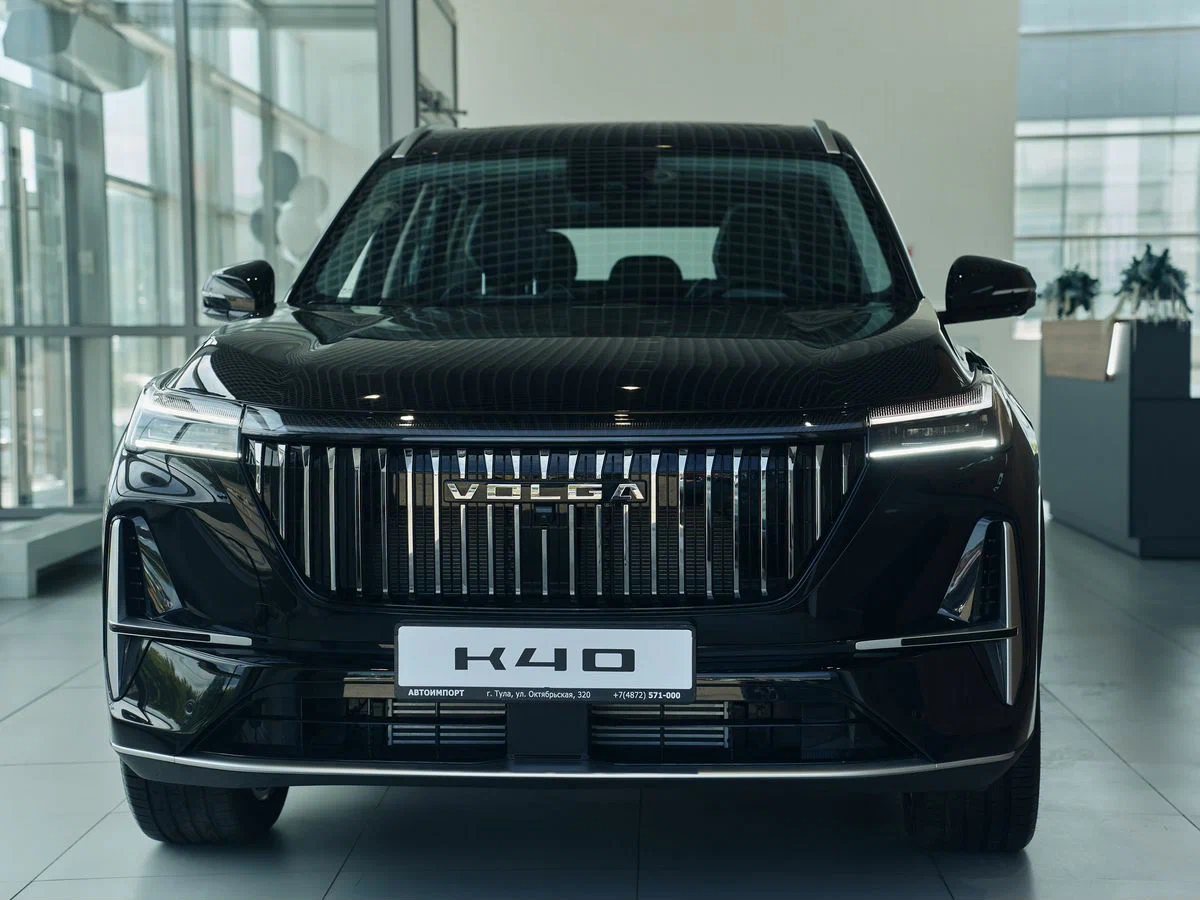
The Volga K40 is one of the most notable new cars on the Russian market in 2026. Formally, this is a domestic crossover from the revived Volga brand, but technically, the model is closely related to the Chinese platform and components. Therefore, evaluating the K40 solely as a “new Volga” isn’t entirely accurate: it’s much more important to understand what exactly the buyer gets for 2.85–3.9 million rubles and how well the car lives up to that price.
The Volga K40 has its strengths: a spacious interior, large trunk, high ground clearance, turbocharged engines, and the option of all-wheel drive. But there are also compromises: the base version is noticeably simpler than the higher trim levels, the multimedia system takes some getting used to, and the level of localization is still a separate issue.
Let’s figure out what are the pros and cons of the Volga K40, which trim level makes sense to consider and who this crossover is really suitable for .
What is the Volga K40
The Volga K40 belongs to the mid-size crossovers. The length of the car is 4678 mm, the width is 1900 mm, the height is 1705 mm, and the wheelbase reaches 2760 mm. Ground clearance is declared at 215 mm.
In terms of size, the K40 is no longer in the category of small city crossovers. This is a fairly large car, designed not only for daily city driving but also for long-distance family trips.

At the same time, there’s no point in hiding the model’s origins. The K40 is technically close to the Chinese Geely Atlas/Boyue L: it borrowed a significant portion of its design and powertrain technology from there. The Russian Volga has a different front end design and brand attributes, and production is organized in Russia.
The main difference within the K40 family is two completely different power versions.
Base modification:
- 1.5 petrol turbo engine;

- 147 hp;
- 270 Nm;
- 7-speed robotic gearbox;
- front-wheel drive;
- acceleration to 100 km / h – about 9.2 seconds;
- declared consumption – 7 l / 100 km;
- AI-92 gasoline.
Older version:
- turbocharged engine 2.0;
- 200 hp;
- 325 Nm;
- 8-speed hydromechanical automatic;
- all-wheel drive;
- 0–100 km / h in 8.6 seconds;

- combined fuel consumption – 8.1 l / 100 km;
- AI-95 gasoline.
It is the difference between these versions that largely determines the pros and cons of the Volga K40.
Plus No. 1. Spacious interior
One of the main advantages of the K40 is the space inside. With a wheelbase of 2760 mm, the car provides enough space for second-row passengers.
This is especially noticeable against the background of many compact crossovers, which look large on the outside, but are much more cramped inside. The K40’s rear seat is designed more for adult passengers than for occasional short trips.
For a family car, this is a significant advantage.
That said, the rear seat’s equipment isn’t exactly outstanding: it’s noticeably simpler than some Chinese competitors. Therefore, the K40’s strength lies primarily in its space , rather than the number of individual rear-seat features.
Pros #2 A huge trunk for its class
Another strong point of the Volga K40 is its trunk.
The trunk volume is 650 liters , and with the rear seats folded, the figure increases to approximately 1,610 liters.
For a family crossover, this is a truly useful feature.
In the K40, you can easily imagine a multi-day trip with a lot of luggage, transporting a stroller, or loading the car with groceries.
And there is an important nuance here: a large trunk is not just a number in the technical specifications. For Russian buyers, this is one of those advantages that can be felt almost every day.
Plus No. 3. Good ground clearance
The ground clearance of the Volga K40 is 215 mm.
This is a serious figure for an urban crossover. The car should feel quite confident on bumpy roads, dirt roads, snow-covered yards and when parking near high curbs.
However, you shouldn’t consider the K40 a full-fledged SUV only because of its ground clearance.
The front-wheel drive version’s capabilities are limited by the lack of all-wheel drive. And the AWD modification, despite the presence of all-wheel drive, remains first and foremost a road crossover.
In other words, 215 mm is a big plus for bad roads, but not a license to storm off-road.
Plus No. 4. A powerful engine and a classic automatic transmission
The Volga K40 version with a 2.0 Turbo engine looks the most interesting technically.
200 hp and 325 Nm are quite impressive figures for a car of this size. Moreover, the engine works together with an 8-speed hydromechanical automatic transmission.
This is a significant advantage over the base car with a 7-speed robot.
For the city, the 1.5T with 147 hp It is quite sufficient, but if the car is regularly driven on the highway, loaded with passengers and luggage, or used outside the city, the two-liter version seems like a more logical choice.
According to official dealers, the K40 2.0T AWD is capable of accelerating to 100 km / h in 8.6 seconds.
That is, the older version should not have a lack of dynamics.
Plus No. 5. All-wheel drive
All-wheel drive is available with a two-liter engine.
And we are not talking about just a decorative AWD for show: the design uses a sixth-generation BorgWarner multi-plate clutch.
For the Russian market, this is a significant argument.
All-wheel drive is useful not only when driving in mud. It helps when starting on snow, wet surfaces, snow-covered roads and uncleaned suburban areas.
It is important to understand: the K40 AWD costs significantly more than a front-wheel drive car.

Plus No. 6. Normal fuel economy considering the size
The declared fuel consumption looks quite moderate.
For 1.5T the manufacturer specifies about 7 l per 100 km, for 2.0T AWD — 8.1 l per 100 km in the combined cycle.
However, it is better to perceive these figures as a guide, and not as a guaranteed consumption in real life.
In the city, the two-liter K40 is capable of consuming significantly more: the technical data for the 2.0T version specifies 10.8 l/100 km in the urban cycle.
Therefore, a potential owner should focus primarily on the urban mode, and not on the passport 8.1 liters.
Minus No. 1. The basic version is noticeably simpler than the higher-end ones
The main problem with the K40 is the very big difference between the trim levels.
The starting price of the car is about 2,849 million rubles, but for this money the buyer gets a front-wheel drive car with a 1.5 engine and a robot.
All-wheel drive starts at about 3,599 million rubles, and the top-end version costs about 3,899 million rubles.
Thus, there is about a million rubles between the basic K40 and a car with a full set of features.
And this is not just a difference in trim.
Additional airbags and a set of electronic assistants appear in the higher-end versions. The basic configuration has a significantly more modest set of systems.
Therefore, comparing the K40 for 2.85 million and the K40 for 3.9 million as the same car is not entirely correct.
Cons #2. Many functions are hidden in the screen
The interior of the K40 is built around a large multimedia system.
A 13.2-inch screen is installed on the center console, through which a significant part of the car’s functions is controlled. In front of the driver is a digital instrument panel with a diagonal of 10.2 inches.
It looks modern, but from an ergonomic point of view, the solution is questionable.
Instead of the usual physical button, the driver has to go to the menu on the screen. For the climate control system and some other functions, this is not always convenient while driving.
Therefore, before purchasing the K40, you should definitely sit in the car and check how this control scheme suits you personally.
Cons #3. Lack of the familiar Apple CarPlay and Android Auto
Another drawback of the multimedia system is the lack of the familiar integration with a smartphone via Apple CarPlay and Android Auto, which was noted during vehicle tests.
For drivers who are used to using a smartphone as a primary navigator, music service, and message source, this may be a serious inconvenience.
Yes, the car has its own multimedia system and Russian services, but the familiar “connected the phone and got a familiar interface” scenario is implemented here differently than in some competitors.
Cons #4. Soundproofing is not a strong point
According to the results of K40 tests, the insufficient level of soundproofing can be considered as a disadvantage of the car.
For the city, this may not be too noticeable. But on the highway, especially at high speeds, acoustic comfort becomes much more important.
And here you need to take into account the size of the car: K40 is intended for use, including for long trips, so the requirements for soundproofing are higher than for a small city crossover.
Con #5. The issue of localization remains open
The name Volga creates the feeling of a completely Russian car, but in fact, the K40 is the result of deep integration with a Chinese automobile platform.
This in itself is not a disadvantage. The problem for the buyer is different: how stable will the system of supplying components be, how quickly will localization expand, and how will this affect the cost of repairs in a few years .
It is difficult to give a definitive answer for a new car.
That is why a potential owner should inquire in advance about the availability of consumables, body parts, and basic suspension components at dealers.
Cons #6. There are not enough real operating statistics yet
This is perhaps the most significant drawback, which cannot be compensated for by attractive characteristics.
Volga K40 is just entering the Russian market, so there is not enough long-term statistics on engines, robotic gearbox, eight-speed automatic, all-wheel drive and electronics yet.
It is impossible to say reliably what the car will look like after 100-150 thousand km of mileage, how much major repairs will cost and how well the liquidity will be preserved.
That is why the buyer of K40 today, to a certain extent, becomes an early user of the model.
What to choose: 1.5 or 2.0?
If the main goal is a city car for quiet operation, the front-wheel drive K40 1.5T looks quite rational.
147 hp enough for everyday driving, the declared consumption is lower, and the starting price is significantly lower.
But if the car is bought as a universal family car for the city, highway and trips out of town, the situation changes.
K40 2.0T AWD offers:
- 200 hp;
- 325 Nm;
- all-wheel drive;
- classic 8-speed automatic;
- higher dynamics;
- extended equipment in the corresponding trim levels.
The downside is obvious – the price is approaching 3.6-3.9 million rubles.
And here the K40 has to be compared not with budget crossovers, but with a large number of Chinese middle-class models.
Is it worth buying a Volga K40?
The Volga K40 turned out to be an ambiguous car, and that is why it should be evaluated not by the brand name, but by a specific configuration.
The strengths of the model are a spacious interior, a huge trunk, 215 mm ground clearance, a modern appearance, turbocharged engines, and in the senior version – 200 hp, a classic automatic and all-wheel drive.
Weaknesses – expensive versions, a noticeable difference in the equipment of the configurations, controversial ergonomics of the multimedia system, the absence of the usual Apple CarPlay and Android Auto, less-than-perfect sound insulation, and a lack of long-term reliability statistics.
The main question when buying a K40, therefore, isn’t “Is this a good Volga?” but something much more practical: does the buyer like the specific trim level for the specific price?
If you’re looking for an affordable family crossover, the base K40 makes sense primarily for its size and space. If you need all-wheel drive, a powerful engine, and extensive features, the car’s price quickly approaches 4 million rubles—and then you need to compare it with alternatives on the market.
The most sensible approach before buying is to go beyond a short test drive. It is worth checking the operation of the robot or automatic in traffic jams, assess the noise insulation on the highway, figure out the multimedia system, look at the actual volume of the trunk and separately find out the cost of maintenance and the availability of basic spare parts.
For a new model, this may be more important than several additional options in the price list.