
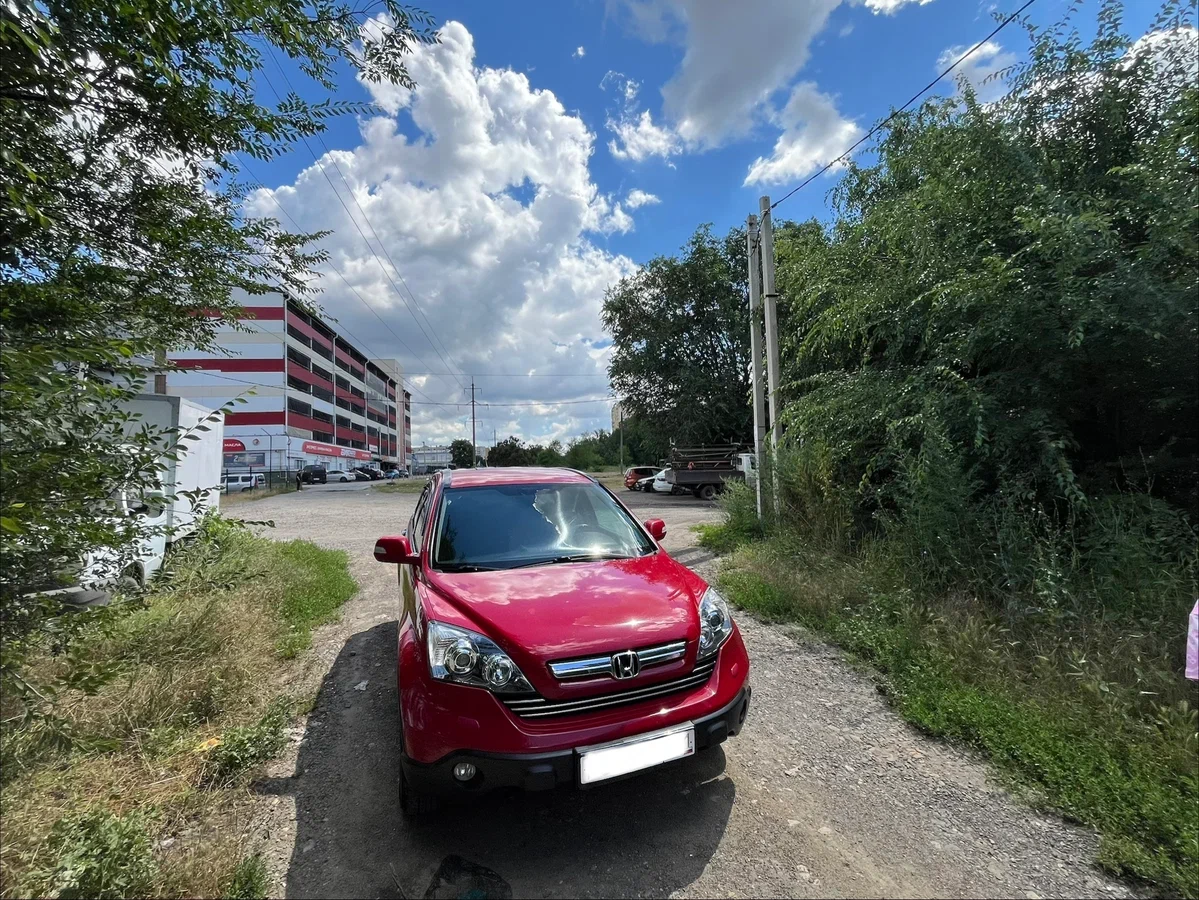
The Honda CR-V has long been considered one of those crossovers that people buy not for its trendy design or luxurious features, but primarily for its practicality and durability. This model remains popular on the used market, despite the age of many vehicles. However, there’s an important caveat: when it comes to used CR-Vs, the condition of the specific model is often more important than the year of manufacture.
According to owner reviews and data from specialized service centers, with proper maintenance, the Honda CR-V can indeed travel 300,000–350,000 km without a major engine overhaul or serious transmission repairs. However, this doesn’t mean that any car with 200,000 km on the clock can be purchased without a diagnostic. Older models develop problems with the suspension, steering rack, all-wheel drive, body, and attachments.

How reliable is the Honda CR-V
The main advantage of the CR-V is its relatively simple and well-studied design. This is especially true for third-generation cars and a significant part of the fourth generation.
The combination of a naturally aspirated gasoline engine and a classic automatic transmission is considered the most successful in terms of durability. The third-generation CR-V was equipped with a 2.0-liter R20 and a 2.4-liter K24. Both engines have a timing chain drive and multipoint injection, and experts estimate their service life before major overhaul at approximately 300,000–350,000 km with normal maintenance.

Honda’s five-speed automatic also has a good reputation. With timely transmission fluid changes, its service life can exceed 300,000 km. An important point is not to postpone maintenance: experts recommend changing the oil approximately every 45,000 km.
Real owners generally confirm this reputation. Reviews include CR-Vs that have been primarily in need of consumables and suspension repairs for years. One owner of a 2008 CR-V with a 2.0-liter engine and automatic notes that even with a mileage of approximately 260,000 km, the engine and automatic transmission remained factory-installed. Other owners of cars from 2004 to 2012 also cite the reliability of the power unit and chassis as their main advantage.

But you shouldn’t count on completely trouble-free operation of an old car. For example, owners of CR-V with mileage over 150-200 thousand km mention steering racks, wheel bearings, suspension components, starters, pumps, air conditioning and various leaks.
Which engine is better to choose
If the main goal is to get the most reliable and relatively simple CR-V, then the most rational option seems to be 2.0-liter naturally aspirated R20 engine in combination with a classic automatic .
Its advantages:
- simple design;
- distributed injection;
- good resource;

- no turbocharging;
- moderate fuel consumption;
- good maintainability;
- a large amount of information on maintenance.
The main disadvantage of the 2.0-liter engine is its not outstanding dynamics. Its capabilities are sufficient for a quiet city driving, but when fully loaded and overtaking on the highway, a more powerful engine feels noticeably preferable.
2.4-liter K24 is a more interesting option for those who need dynamics. It is also considered a reliable naturally aspirated engine and is capable of high mileage, but the maintenance of a specific example must be assessed more carefully. In addition, fuel consumption will be higher.

Therefore, the choice can be formulated simply: 2.0 – rationality and efficiency, 2.4 – dynamics and power reserve.
At the same time, the fourth generation CR-V after restyling got more modern versions of the 2.4-liter engine with direct injection. This engine also has a good resource, but its design is more complex than the early K24 with distributed injection.
Which gearbox is more reliable
Here the advantage should be given to the classic five-speed Honda automatic transmission.
This is especially important for the buyer who wants to minimize potential costs after the purchase. The gearbox has been well studied by specialists, is easy to repair, and with regular oil changes can withstand very high mileage.
A CVT is found in later CR-Vs. It is not considered a failure in itself: specialized experts evaluate its design as quite reliable and point out that under normal operation, serious repairs may be required only after 200 thousand km or more.
However, when buying a car with high mileage, a classic automatic remains a more conservative choice. Especially if the buyer does not know the service history of the car.
What the owners say
According to owner reviews, the Honda CR-V has several consistent advantages.
The first is practicality . Owners regularly note the spacious interior, large trunk, convenient rear seat transformation, and excellent visibility. The car remains quite comfortable for a family, even by modern standards.
Second is controllability . Despite its crossover format, CR-Vs of many generations have a passenger-car character and predictable behavior on the road.
Third is repairability . In their reviews, owners note the large number of similar models, the availability of used parts, and parts from dismantlers. This is especially noticeable in the Far East, where the Honda fleet is traditionally large.
But there are also downsides. Most often, owners cite insufficient sound insulation, age-related body problems, and the relatively high cost of some original parts.
Are there spare parts for the Honda CR-V?
Despite Honda’s withdrawal from the Russian new car market, the situation with spare parts for the CR-V remains generally acceptable. .
The market offers original parts, high-quality analogs, contract units, and components from dismantling yards. The most common items for the suspension, brake system, filters, belts, technical fluids, and many other consumables are much easier to find than rare body or electronic components.
That is why the CR-V compares favorably with some less common cars that are formally younger, but have a much worse supply of spare parts.
However, it would be wrong to consider Honda cheap to maintain. One of the owners of the 2008 CR-V directly notes the high cost of individual spare parts, although with the right selection of analogs and the use of contract parts, costs can be reduced.
What breaks down in a used Honda CR-V
In a car with high mileage, the main attention should be paid not so much to the engine, but to other components.
Suspension. After 150-200 thousand km, it may be necessary to replace ball joints, silent blocks, stabilizer struts and bushings, wheel bearings and other elements.
Steering rack. Backlash and knocking become one of the typical issues in older cars. In reviews, owners separately mention the rack as a component that needs to be monitored at high mileage.
All-wheel drive. The CR-V is not a real SUV. The rear axle coupling does not like heavy off-roading, overheating and water ingress. When buying a car with 4WD, it is imperative to check the operation of the all-wheel drive.
Propeller shaft. At high mileage, wear of the universal joints is possible; experts point to a range of about 180-200 thousand km as one of the guidelines for the appearance of corresponding problems.
Body. In older cars, it is necessary to carefully check the arches, sills, underbody, rear of the body and power elements. This is especially true for cars that have been used for many years in regions with reagents and a humid climate.
Which Honda CR-V is better to buy on the secondary market
If reliability is a priority, I would consider the car according to the following principle:
Honda CR-V III generation + 2.0 R20 + 5-speed automatic transmission is one of the most rational options for those who value simplicity and resource.
Honda CR-V III + 2.4 K24 + 5-speed automatic transmission is a good choice if you want more vigorous dynamics. With a good engine and gearbox condition, this combination also has an excellent reputation.
Honda CR-V IV + 2.4 + automatic transmission is an interesting option with a confirmed service history. The car is noticeably more modern and comfortable, but the cost of a good example will be higher.
CR-V with a CVT also cannot be automatically excluded. But when buying a car with high mileage, you need to especially carefully check the fluid change history, the behavior of the transmission under load and the absence of extraneous noise.
The main risk is buying the wrong CR-V
Perhaps this is the most important rule when buying a Honda CR-V.
The reliability of this model does not mean that you can buy the first car you see. Today, many CR-Vs are more than 10–15 years old and have mileage well over 200,000 km. During this time, even a very reliable design could have been repaired several times.
Therefore, a car with an honest 220 thousand km and a good history may be much more profitable than a car with a declared 140 thousand km, but an unknown past.
Before purchasing, you need to check:
- actual mileage;
- engine operation when cold and hot;
- condition of automatic transmission or CVT;
- presence of leaks;
- operation of all-wheel drive;
- steering rack;
- suspension and wheel bearings;
- condition of the body and underbody;
- condition of the air conditioning system;
- service history;
- compliance of mileage with wear of the interior and controls.
Is it worth buying a used Honda CR-V
Yes, the Honda CR-V remains one of the interesting options on the secondary market, if you need a practical family crossover with a good resource.
Its strengths are reliable naturally aspirated engines, resource transmission, A roomy interior, a convenient trunk, good handling, and a well-developed spare parts market. Real owner reviews generally confirm the model’s reputation: many cars run for years without serious breakdowns, limiting themselves to maintenance and suspension repairs.
However, the Honda CR-V cannot be called a cheap car in all respects. Original parts can be expensive, and older models require investment in the chassis, steering, body, and all-wheel drive.
The optimal choice for maximum reliability is a well-maintained CR-V with a naturally aspirated 2.0- or 2.4-liter engine and a classic automatic transmission. However, the condition of a specific car is more important than what is written in the ad.
That is why, when buying an older CR-V, it is better to pay for a full diagnostic before the transaction than to save on an inspection and then restore the car after purchase. Previously, the ufocar.ru portal reported on the advantages and disadvantages of the BelGee X50+ crossover.