
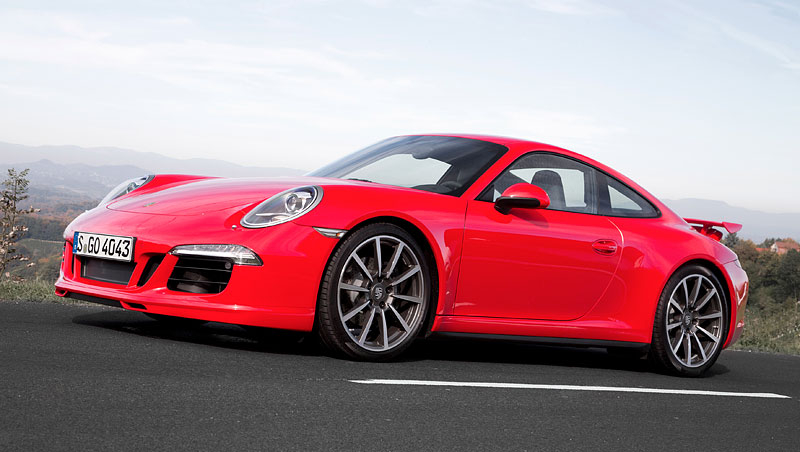
As children, many of us dreamed of getting behind the wheel of a race car—and not just getting in, but actually driving it and flooring the gas pedal. Unfortunately, not everyone in our country can afford a sports car. The editor of the “Auto” project went for a test drive, where he spurred on the red steed of the Porsche 911 Carrera 4.
A Legend in Seven Generations
My first encounter with the legendary Carrera happened several years ago at the Moscow Raceway: back then, in pouring rain, the Porsche 911 and my aggressive driving style nearly cost me the track. Now, I decided to test the updated Porsche 911 in a more relaxed mode, not on the track, but outside the city. I set off for the village of Olginskaya in a legendary sports car.


Well, first, I’ll tell you a little history. The legendary Porsche 911 sports car appeared more than half a century ago. Back in 1964, Ferdinand Porsche’s grandson, Alexander, designed a two-door coupe that was destined to become an icon. The new Porsche replaced the 356 model. By the early 70s, the 911 entered motorsports, and in honor of its victories at the famous Carrera Panamericana circuit race, the car received another name – Carrera. With each passing year, the 911 became better and better, faster and safer. In the 80s, Porsche used only advanced technologies. At the same time, the classic 911’s appearance remained unchanged for 26 years. The second-generation coupe appeared in the early 1990s. Its dimensions and styling mirrored those of its predecessor. This continued from year to year, from generation to generation. In the early 2000s, the 996 body style appeared, which is considered the most controversial Carrera model of all time, as Porsche engineers deviated slightly from the classic 911 canons during its design. The historic style returned with the 997, which many called the return of a legend. Following it was the 991 body style, which was visually virtually indistinguishable from its predecessor. This year, the car underwent a restyling, although again, the visual changes are minimal. This is the one we have for testing today.
Over seven generations, the Porsche 911 Carrera has become recognizable at first glance, no matter what year it was produced. Moreover, this legendary sports car was included in the list of cars that changed the world and took fifth place in the list of the best cars of the 20th century.
Turbodrive
I got my hands on not just any 911, but an all-wheel-drive Carrera 4S. As I already mentioned, the new model traditionally follows its predecessor’s appearance, and its exterior has hints of the classic model. However, now all engines are turbocharged. If a turbocharged car was previously called a Turbo, now even the base 911 has a turbocharged engine, not a naturally aspirated one. In this case, it is recommended to fill the engine with 98-octane gasoline.


The impeccable Porsche style is represented by wide rear and front arches, a frog-like appearance, as well as a long hood and round headlights with LED optics. Compared to the pre-restyling version, this year the car received slightly modified bumpers. This was done for the sake of ecology and fuel economy. The new three-liter engine develops a power of 370 horsepower.
You can recognize the updated model from the rear by the relief lights and a grille with vertical slats. For a more striking appearance, you can raise the rear spoiler, or it automatically extends at a speed of 120 km/h.
Classic with a modern edge
Inside the new model, there is a steering wheel similar to that of the Porsche 918 supercar and a multimedia system with a touchscreen. Modern elements fit well into the rather conservative interior. The classic look with a modern edge is also evident in the instrument dials. The tachometer is located in the center, and the speedometer is on the side – in a sports car, it is not the main one.
The steering wheel houses the mode selector switch. The Sport Response button mobilizes all the car’s reserves for 20 seconds, and launch control makes acceleration from a standing start as efficient as possible.


Technical capabilities
When driving, the sports car’s steering is sharp, and the car responds to the slightest turn of the steering wheel. The seven-speed PDK robot allows the Carrera to accelerate dynamically. Thus, the 911 accelerates from 0 to 100 km/h in 4.3 seconds, and reaches 160 km/h in 9.7 seconds. But high-speed runs are better practiced on the track, and not in everyday life, especially since the top speed of the 911 is limited at 292 km/h. The 2016 restyling of the 991 II technically did not change the all-wheel drive system, only the PTM response time was improved and more traction torque was transferred to the front axle. The 911’s handling has always been considered close to the benchmark, and the maximum capabilities of this chassis are great.
The electronically controlled shock absorbers have a wider working range, and the rear-wheel steering allows for effective cornering at high speeds.


After the restyling, the naturally aspirated boxer engines were reduced in displacement and became bi-turbocharged. This, of course, improved dynamic performance and fuel economy, but the wonderful sound of the naturally aspirated engine was lost. There’s a button on the center console specifically for this purpose that activates the sports exhaust.
However, in everyday life, using this full arsenal isn’t always possible if you don’t want to run into fines. I didn’t break any rules, though, even though the car was constantly provoking me. For example, while starting off on the highway using launch control, a Zhiguli driver backed me up, but when I spun the 911 into a dead stop within seconds, the man, stunned by my performance, leaned out the window. Of course, the Carrera is a legendary sports car that can be used every day, but if you want to get a real thrill from the car and reveal all its capabilities, it is better to go to the track, and not scare ordinary motorists on public roads.