
When winter approaches, each of us begins to recall the warm summer and the vivid impressions it left behind. It’s like we’re writing an essay on the topic: “How I Spent My Summer.” In the case of “Southern Automobile,” we had a very bright and unforgettable summer, just like the updated Nissan GT-R R35i. It was this car that we truly enjoyed this summer after nine laps at the Sochi Autodrom.
Eclipsed the Horizon
With the introduction of the GT-R sports coupe in 2007, the Nissan brand entered the elite club of supercars. Then, ten years ago, the Skyline GT-R was renamed simply to GT-R, and this was due not only to marketing considerations, but to a fundamentally changed concept of a sports car.
If up until the R34 generation, the Skyline GT-R was essentially an improved Skyline, now the GT-R is a fundamentally different car, which stands head and shoulders above the T-34 in technological terms, and calling it a Skyline would be completely wrong. The R35 generation is a fully-fledged supercar, capable of delivering lap times in stock form on par with its more elite German or even Italian counterparts, while costing significantly less.
At one time, the GT-R even set a record for the Nordschleife at the famous Nürburgring track.

Thanks to its relatively low price for a car of this caliber, the GTR 35 has become a favorite model for all sorts of tuners and drifters.
Drift and drag racing enthusiasts easily boost the 3.8-liter V6 gasoline engine to 1,000 horsepower or more. In stock form, the engine produces 555 horsepower, which, you’ll agree, is also quite impressive. Like many elite supercars, the engine is assembled entirely by hand by Japanese takumi artisans, as evidenced by the corresponding nameplate.
This year, the Nissan GT-R received a minor restyling and became even better. While the pre-restyling R35 was more focused on the track, engineers have now tweaked the suspension, making the “Godzilla” more enjoyable in the city. Despite its large and heavy size, it develops excellent speed and demonstrates excellent handling both on the track and in the city. These qualities are what attract buyers and a throng of fans.
As for the R35’s post-restyling changes, they are there, but they most likely relate to refinements to the engine. Thus, Nissan engineers reprogrammed the engine control unit, due to which its power increased by another 15 horsepower and now amounts to 570 horsepower.

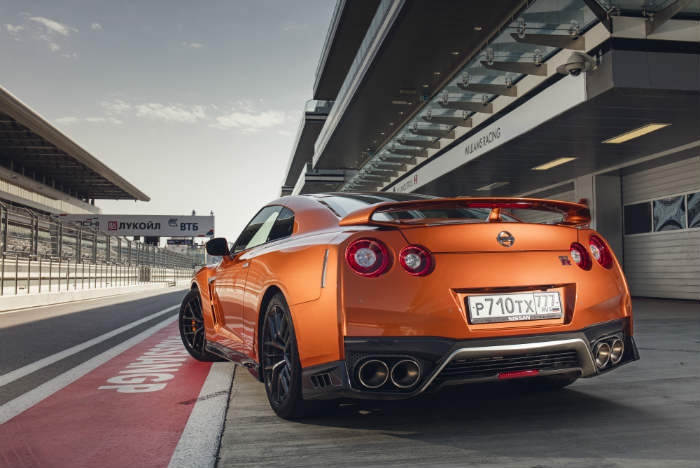
In addition, the updated GT-R received a completely new exhaust system made of high-strength titanium. A redesigned front spoiler, reinforced hood, new side skirts contribute to increased downforce, it now amounts to 160 kg.
Due to the elongated rear roof pillars, air turbulence is no longer formed, accordingly, aerodynamics have improved. Nissan engineers paid great attention to improving aerodynamic performance, as well as additional cooling of key components of the car. During the update, the GT-R received a new front bumper with an increased area of air ducts for better cooling of the engine radiator, while the lower edge of the bumper was redesigned to maintain high downforce. New side sills and a rear bumper reduce underbody airflow and turbulence at the rear of the car, improving handling at speeds over 250 km/h.
The radiator grille area has been enlarged, increasing air flow to the engine by 20%, so even when used on a racetrack in 40-degree heat, this will not lead to overheating. However, these are all theoretical aspects; it’s time to move on to practice.

On your marks! Attention! Go!
The Sochi Autodrome is a serious matter, especially behind the wheel of a 500+ horsepower car. You need to be extremely careful here, as the speeds are very high. A special feature of the track is that there are no so-called gravel or sand traps that would slow you down if you make a mistake when entering a turn. The entire track is surrounded by concrete barriers, and accidents at the Sochi Autodrom can have serious consequences.
Furthermore, before the races, each of the journalists participating in the test drives was tested for alcohol in the blood and had their blood pressure measured. So, the medical examination is complete – I pull a balaclava over my head and put on a helmet, and head down to the pitlane, where “Godzilla” is already waiting for me.
Like any supercar, getting behind the wheel of the Nissan GT-R is not easy; you have to bend over halfway to enter. The rather hard seats, personally, reminded me of the driving position of a Porsche 911, with the only difference being that in the Porsche you sit a little lower. The interior is designed in austere forms. The center console and seats are covered in Nappa leather in the same bright orange color as the GT-R body itself. Incidentally, this bright orange interior and exterior became available only after the car was updated. A decorative carbon fiber trim has been installed on the central tunnel. The steering wheel paddle has become rounded. The number of buttons on the spokes has been halved, and the paddle shifters have been moved from the console to the steering wheel. Now they rotate with the steering wheel and can be clicked during active steering. The instruments are extremely simplistic, and there is even a head-up display.
Finally, I start the engine and hear Godzilla’s deep roar. In our case, the organizers offered us three sets of three laps for the race—nine laps in total. The first lap is a familiarization lap, the second is a test lap, and the third is a cooling lap. Personally, this isn’t my first time driving at Sochi Autodrom, but I still feel a little nervous.
I slowly pull into the pit lane, and then onto the track. We accelerate gradually, recalling the track and every turn. Finally, in R mode, we reach the test lap. The instructor, sitting in the passenger seat, suggests the best way to take this or that turn.

The engine power is delivered to all four wheels of the new GT-R via the unique ATTESA E-TS all-wheel drive transmission, in which the gearbox is installed in the same block as the final drive of the rear axle.
During normal driving, the GT-R behaves like a rear-wheel drive car (the engine torque redistribution is 0:100 in favor of the rear axle), but depending on the speed, lateral acceleration, steering angle, road conditions and the amount of tire grip, torque from the engine can also be transmitted to the front axle.
At the same time, I want to say that the Nissan GT-R is quite a heavy car – 1750 kg and on the track this excess weight requires confident maneuvering. But Nissan has learned to use the extra weight to their advantage. The weight is adapted to the all-wheel drive system.

Electronic systems distribute torque to the wheels so that the car is maximally loaded. “Brake on straight wheels, we try to load the front of the car before the turn,” my instructor suggests. And this is an effective tactic for cornering. You have to actively press the brake pedal to the floor, but do it confidently, not abruptly. In this way, the all-wheel drive system distributes the load. So, when entering a turn with active braking, the car’s weight shifts towards the front axle due to inertia, and when you open the gas, it shifts towards the rear, which ultimately results in a weight ratio of approximately 50:50. This allows the car to traverse the track at the same level as lighter sports cars.
At the same time, when exiting turns, you need to open the gas and hold it steady. There is one long turn at the Sochi Autodrom, about 650 meters long, the so-called fast one. This is precisely the section that needs to be taken with a steady throttle at a speed of 150-160 km/h, and the key is not to overdo it, otherwise the car starts to drift to the outside of the turn, which is felt by the wheels starting to squeal.
Generally, those ordinary people who think that turns should be taken with squealing wheels don’t understand anything about racing driving. Turns need to be taken on the flattest possible trajectory, otherwise you won’t get a fast lap, and it’s easy to fly off the track.

Before the finish line, you have the opportunity to drive around the Sochi Autodrom at the highest possible speed. I managed to accelerate the car to 220-230 km/h, although professional racers and instructors take this section at 250-260 km/h. As for Formula 1 cars, they reach speeds of 300-310 km/h on this same section, so I’m still quite a slow driver.
After a challenging lap, I slow down and drive in a relaxed mode to cool down the car’s components. The previous GTR R35’s engine overheating was a problem compared to the updated one, but in Sochi, with an air temperature of 35 degrees and asphalt at 42 degrees, all temperature readings of the updated GTR were normal. However, the drivers had a hard time getting out of the GTR’s wheel. The car made them sweat so much that their shirts and balaclavas were actually wet. It’s a good thing the test drive organizers didn’t do time trials, otherwise it would have been a true endurance race.

One of the most affordable supercars
Today, the Nissan GT-R is one of the most affordable supercars on the domestic market. The extensive list of standard equipment in the Black Edition trim level also includes options such as a black leather interior with red accents, Recaro sports seats, and a metallic body color. The price of the car in the Black Edition trim level is 6,875,000 rubles. The Prestige trim level, in addition to all the options and main advantages of the Black Edition trim level, includes a choice of interior trim colors (brown, black, ivory, red), as well as leather sports seats. The price of the car in the Prestige configuration is 6,975,000 rubles.