
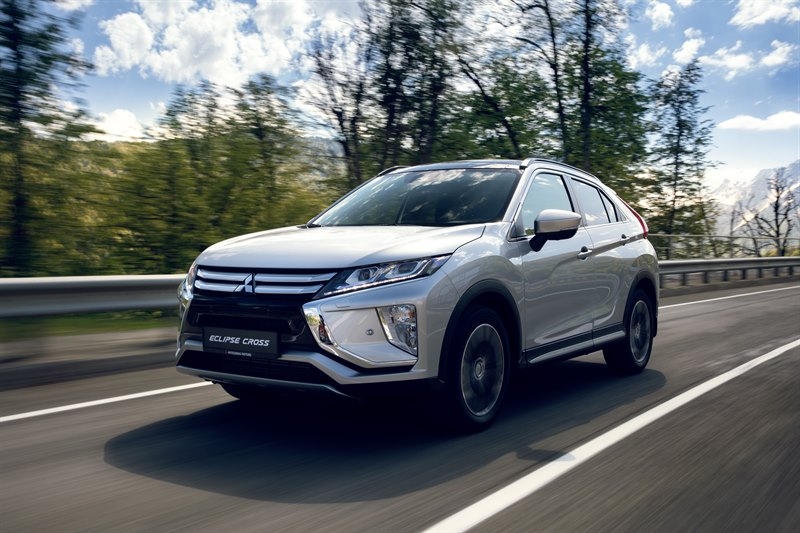
Mitsubishi has always been renowned for its practical, utilitarian, and reliable SUVs. For this reason, the primary target audience for the brand’s off-road model line was people over forty. Those who needed to travel long distances, where there was no good asphalt, and who also needed to carry a lot of gear. But now Mitsubishi is embracing youth and sportiness with the stylish new Eclipse Cross crossover coupe.

Until recently, the compact crossover segment for the Japanese brand Mitsubishi was practically nonexistent. Yes, there is an ASX model in the lineup, fans of the brand might argue, but it has had a rather strange history in our country. First it was introduced, then it was removed, then it was brought back again, but apparently a middle ground between the large Outlander and the compact ASX was still missing.
And now we have a completely new car, unlike any previous Mitsubishi model—stylish, bright, compact, and even in the now-fashionable coupe-like body style—the Eclipse Cross crossover. For many of us, the name Eclipse is a long-familiar one; it was the name of a Mitsubishi sports coupe sold in the early 1990s. The car was later discontinued, but left only warm memories.

Now the Eclipse is not just a coupe, but a crossover coupe, as evidenced not only by its sloping rear door but also by the “Cross” prefix in the name. It’s worth noting that the model turned out to be impressive. During a test drive near Krasnaya Polyana, the Eclipse Cross attracted the attention of not only drivers but also random passersby. People approached and asked what kind of attractive Mitsubishi it was. One Sochi taxi driver even asked: “Is it like the Nissan Juke?” And his words have a logical grain in terms of comparing these two cars. Although Mitsubishi itself does not position the new Eclipse Cross as a classmate of the Nissan Juke. These cars share the same creator – designer Tsunehiro Kunimoto, who moved from Nissan to Mitsubishi three years ago.

Sensei Tsunehiro has done his best and created a bold car that strives to stand out from the crowd of similar urban crossovers. Moreover, no one even expected to see such a car in the Mitsubishi lineup. Although, in some ways, it’s a good thing that Mitsubishi joined the Nissan-Renault alliance; perhaps more striking-looking cars will appear. Although the Eclipse Cross occupies an intermediate position between the ASX and Outlander, all three cars share the same wheelbase at 2,670 mm, meaning they are all built on the same GS platform. Although the Eclipse Cross looks more impressive than all the SUVs in the Mitsubishi lineup, it still continues the Dynamic Shield design strategy, introduced back in 2014.

Let’s go
Now many car brands conduct test drives for journalists in Sochi, and Mitsubishi is no exception. This city and its surroundings allow you to test the car in completely different conditions, from perfectly smooth asphalt to driving on rugged mountain terrain, which is actually why we came here.
The Eclipse Cross crossover is positioned as an urban crossover, which, with desire and skill, can force off-road conditions and even shallow fords. With 183 mm of ground clearance and approach/departure angles of 18.8 and 29.2 mm, you’ll feel confident navigating city tram tracks, uneven surfaces, and low curbs, as well as country roads and even gravel. The base Eclipse comes with front-wheel drive, but we have the top-of-the-line Ultimate trim with all-wheel drive. Under the hood of our Eclipse Cross is a 1.5-liter turbocharged gasoline engine producing 150 horsepower and 250 Nm of torque. In Europe, this same engine produces 163 horsepower, but in ours, it’s slightly detuned.

From the first meters on asphalt, the car feels nimble and dynamic. Mitsubishi representatives claim that the compact Eclipse Cross is as dynamic as the larger Outlander with its naturally aspirated 2.4-liter engine. Despite the Eclipse Cross’s turbocharged engine, there’s no need to worry about 92-octane gasoline. The manufacturer itself recommends it. The engine is paired with an X-tronic CVT from Jatco. The CVT features a Step-Up control system, which gives the driver a feel of shifting gears. This makes it feel like you’re driving a regular automatic rather than a CVT.

All-wheel drive
The Eclipse Cross features the S-AWC all-wheel drive system, but it shouldn’t be compared to the all-wheel drive on the legendary Evolution. Using a similar name is more of a marketing ploy here. The system distributes traction and braking force between all four wheels, and can also distribute torque between the left and right wheels. This improves handling when cornering, ensures stable straight-line driving, and ensures safety on slippery roads. Off-road capability is also possible, but not on particularly rugged terrain. As one of the tests, the organizers prepared us for a climb up a serpentine mountain road, where instead of asphalt, there was first gravel, and then clay and gravel. By the way, to make driving off-pavement easier, you can select Gravel or Snow mode. When driving on gravel, the Eclipse Cross handles well; sometimes on long climbs, the CVT is a bit sluggish, but in this case, you can switch manually using the steering wheel paddle shifters.

A little higher up the mountain, the gravel began to mix with clay, and then it became more difficult. The car moves, but it feels a bit labored. If the Eclipse Cross had knobby tires, it might have mastered this challenge as well. We didn’t dare drive further up the mountain on clay – we were afraid of getting stuck or overheating the CVT. But then, what do you expect from a city crossover? It handled itself well; its element is the city, not the mountain hiking trails the locals climb in UAZs.
Interior
Typically, most test drives begin with a tour of the interior and trunk, but we’d like to finish there. The dashboard, while distinctive, still bears some resemblance to the Outlander, but the ergonomics aren’t compromised. The seven-inch screen displays navigation maps or images from the 360-degree and bird’s-eye cameras. The multimedia system supports Apple CarPlay and Android Auto. The multimedia system can be controlled using both the touchscreen and the touchpad. If you’re a music lover, you’ll appreciate the Rockford Fosgate audio system with an amplifier and subwoofer.

Top-of-the-line trims will get a panoramic roof to reduce the feeling of cramped interior space. A head-up display has also been added. I don’t think it’s necessary, but many drivers appreciate it. Adaptive cruise control will allow you to cover long distances without getting too tired. Overall, this small crossover packs so many intelligent systems that it rivals many more expensive and premium crossovers. The low-speed collision avoidance system alone is a real highlight. It helps prevent sudden acceleration and reduces the consequences of rear-end collisions while parking.

The system reduces engine power for approximately 5 seconds if it detects that there is an obstacle approximately 4 meters in front of or behind the car and that the accelerator pedal is pressed quickly and very hard. The system is activated when the car is stationary or moving at speeds up to approximately 10 km/h. Among other things, it has heated front and rear seats, a windshield, a steering wheel, and much more. Mitsubishi has not forgotten about family buyers either; attaching a child seat with Isofix will be much easier. As for the trunk, it is certainly small. The usable volume is smaller than most of its classmates. For the sake of design, due to the sloping trunk lid, its capacity had to be sacrificed. The full-size spare tire also takes up a lot of space.

About prices
The minimum price of the Eclipse Cross crossover starts at 1,399,000 rubles. For this money, they offer the Invite trim level with a manual transmission and front-wheel drive. The most popular front-wheel drive Intense and Instyle trim levels with a CVT will be. The price of such cars, depending on options, varies between 1,629,000 and 1,819,000 rubles. The top-of-the-line Ultimate version with all-wheel drive and a set of all kinds of electronic gadgets crosses the two million mark. You will have to pay 2,159,990 rubles for the “Ultimate”. Mitsubishi sees the new model’s primary target audience as young people who enjoy sports and an active lifestyle. However, the car is also likely to appeal to young women and young mothers. At the same time, according to Mitsubishi marketers, the very first buyer of the new Mitsubishi Eclipse Cross was a 60-year-old man, but who is actively involved in sports, so he aims the new crossover at the widest target audience.