
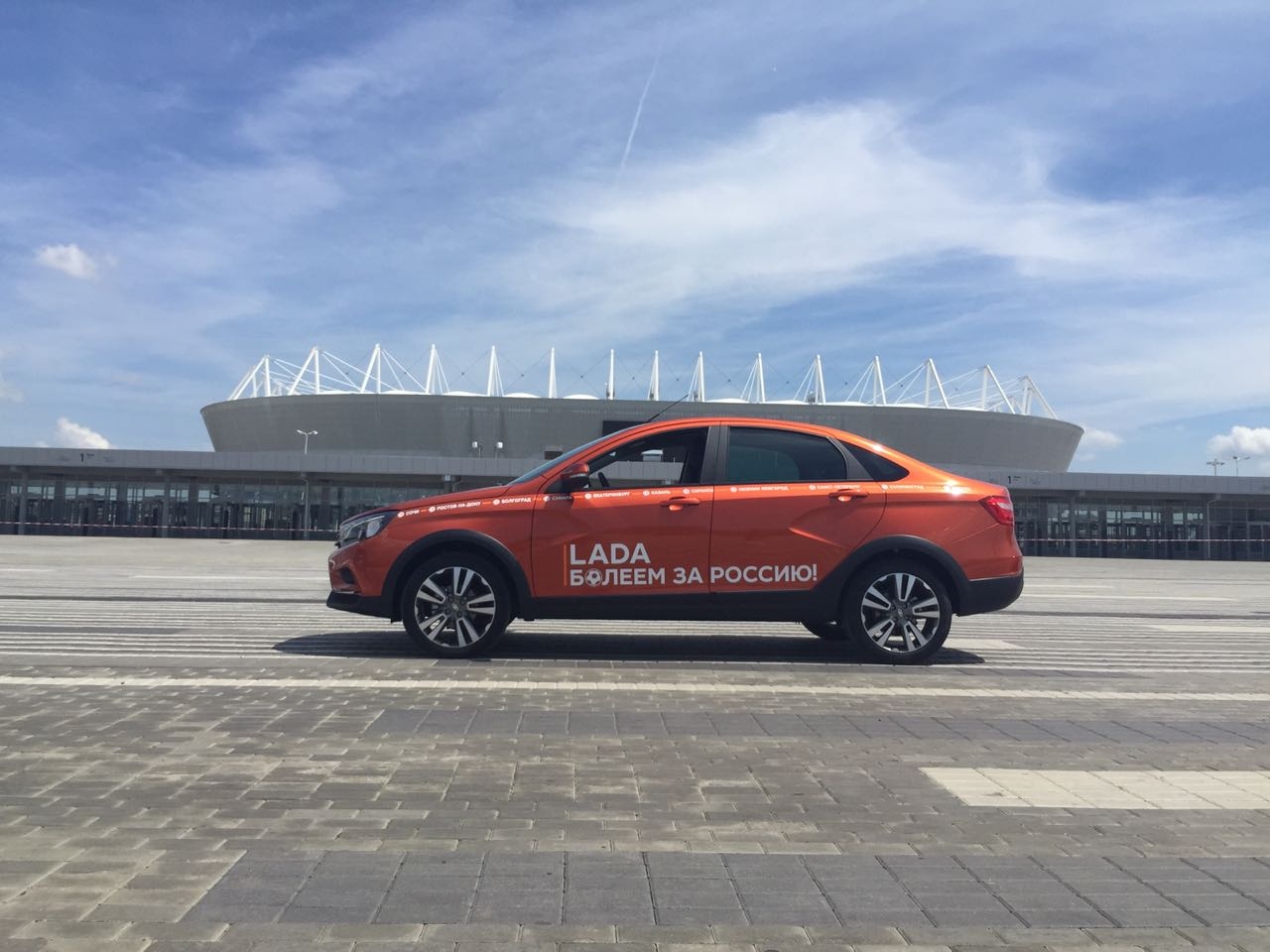
The success of the Lada Vesta is forcing AvtoVAZ to adapt to consumer demands by expanding its model lineup. Following the standard sedan, a station wagon and its off-road version, the SW Cross, have appeared, with the waiting list at some dealers stretching four months. Now the Lada lineup also includes a sedan with increased ground clearance and the “Cross” prefix in its name. We drove the Cross sedan for 1,500 kilometers to find out how it differs from the station wagon and what its pros and cons are.

Differences between the Cross sedan and station wagon
Technically, the SW Cross sedan, with the same prefix, is no different from the SW Cross station wagon. They have the same engines, the same increased ground clearance of 203 mm, disc brakes all round, 17-inch wheels with a blacked-out finish, and plastic trim along the lower body. The cars differ only in the body shape. To reduce production costs, the Cross sedan is completely unified with the station wagon. The SUV sedan has slightly stiffer rear springs due to its rear being lighter than the station wagon.

Otherwise, the cars are absolutely identical. The Cross sedan is sold only in the Luxe trim, and accordingly, its price starts at 763,900 rubles. This is 63,000 rubles more expensive than the standard Vesta sedan in the Luxe trim and 32,000 rubles cheaper than the crossover station wagon. Therefore, the cross station wagon and sedan differ only in profile; if you look at the cars head-on, it will be impossible to tell them apart.
Let’s go
Sales of the Vesta Cross sedan will begin on June 1st. On this day, the Lada Vesta Cross sedan rally through the cities hosting the World Cup will come to an end. Several cars from the first production batch were given to journalists, and they set off on a journey through the cities and villages. We were given a section of about 1,500 kilometers – Rostov-on-Don – Volgograd – Saratov – Samara.

During this time, we were supposed to get a feel for the new model. While the roads in the Rostov region are somewhat reminiscent of good asphalt, in the Volgograd and Saratov regions the road surface in places resembles a battlefield. AvtoVAZ representatives test-drove cars in “Mars” (orange) and “Pluto” (gray) colors, each with a five-speed manual transmission from Renault and a 1.8-liter engine producing 122 horsepower. A 1.6-liter engine is also available, but none of these were available during the test drive. Incidentally, the top-end versions also offer a robotized transmission, but none of these were available. The Cross sedan with two pedals costs 859,900 rubles. In fact, not only journalists but also owners themselves expressed dissatisfaction with the robotized transmission and its sluggish shifting. According to AvtoVAZ, the robotic transmission was modified to meet customer requests, but such cars were not included in the test run.

As for leisurely driving, in city mode, the car with a 1.8 liter engine drives quite briskly, allowing you to freely change lanes and overtake. In my opinion, even with the climate control turned on (it is dual-zone here), there is no noticeable power take-off. I would also like to note the fairly smooth pedal travel, which makes driving in traffic jams easier. At the same time, the suspension copes well with the unevenness of the urban landscape, such as small potholes, tram tracks and speed bumps.

Highway
On country roads, given that our car has a 1.8 engine, there is no particular dynamic feeling. The VAZ-21179 engine is gradually being improved, but there are still some issues. You have to constantly rev the engine when overtaking, and do so in third gear. Another unpleasant issue is the aerodynamic whistle coming from the upper part of the driver’s door at high speeds. Also, in my experience, at speeds around 110 km/h, when overtaking, the car begins to emit a slight shudder or hum. I haven’t had a chance to test the 1.6 engine; the car will likely be even slower with the smaller engine. However, the poor performance may also be due to the fact that the cars were just off the assembly line and haven’t been broken in yet.

When we picked up the car, the odometer showed less than 1,000 kilometers. Perhaps after 3,000-5,000 kilometers, the car will perform better. According to the specifications, the Vesta Cross sedan with a 1.8-liter engine and manual transmission accelerates from zero to 100 km/h in 10.5 seconds, and the top speed is 180 km/h. According to the manufacturer, fuel consumption is 9 liters per 100 km, but we achieved 10.2 liters per 100 km with active shifting and overtaking long trucks. Still a bit much.

Off-road
Several times during the trip, we deviated from the main route to drive to the banks of the Volga. The car handles confidently on country roads and ruts, helped by its 203 mm ground clearance. It can even go where most front-wheel-drive crossovers cannot. If the Vesta sedan had all-wheel drive, we could have conquered even more serious obstacles. In other words, the Vesta Cross is a car for those who want a sedan but aren’t willing to pay for all-wheel drive and a crossover body. It’s also good that the Vesta Cross has a flat underbody, so there’s no fear of hitting anything.

The Lada Vesta Cross’s off-road capabilities are limited only by the lack of all-wheel drive and the rather poor geometry of the front overhang. On steep, rutted descents, you might scrape the bumper lip. The dynamic stabilization system is switchable, the traction control system tries to imitate the work of a limited-slip differential, there is even a hill start assist system.

A little about the interior
The interior is completely identical to the Cross station wagon, with the only difference being that in our car, instead of bright orange, there are pleasant silver inserts. They have a pattern on top, which does not look particularly attractive. It would be better to leave them in a single color. The steering wheel can be adjusted not only for height, but also for reach. There is a heated windshield, front and even rear seats. In the top-end configurations, like ours, there are USB sockets not only for the driver, but also for rear passengers. The instrument dials, although large, are a bit blind. So is the multimedia system screen. It’s quite difficult to read the text in direct sunlight. Another plus is the rearview camera with dynamic markings.

Verdict
I’d like to say that I personally like the Vesta Cross wagon better, as do many others, but in traffic, the sedan also attracts attention, especially from those looking at you from behind the wheel of a regular Vesta. The sedan will cost you less, but you’ll have to sacrifice some trunk space. With a base price of 763,900, the car is very well-equipped. Of course, the car isn’t without its flaws, but there are still some improvements. The off-road sedan will definitely find its buyer, plus those who love the now-discontinued Priora will definitely switch to it. And if you compare the Priora and Vesta, there is a tremendous amount of progress between these two cars.