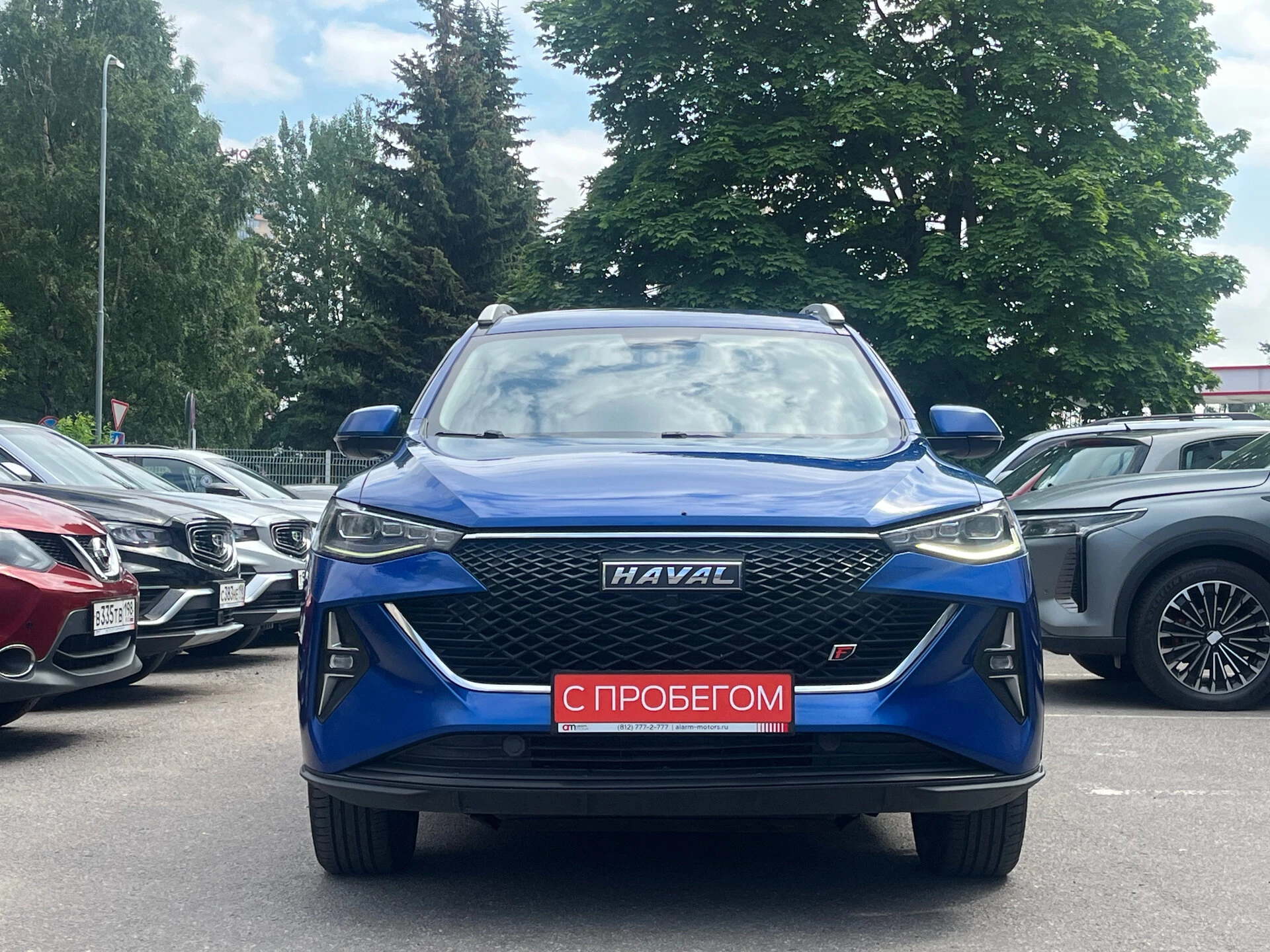
Just a few years ago, many were wary of Chinese cars. However, the Haval F7 has managed to change the minds of thousands of Russian drivers. The crossover quickly became one of the most popular representatives of its class due to its modern design, rich equipment and localized production in Russia.

Now more and more cars with a mileage of 70-150 thousand kilometers are appearing on the secondary market, and potential buyers are asking the main question: is it worth buying a used Haval F7 or is it better to look for a Japanese or Korean analogue?

We figure out what pros and cons the model has, what malfunctions owners encounter and how reliable the Chinese crossover turned out to be after several years of operation.
What is the Haval F7
The first generation of Haval F7 has been produced in Russia since 2019. The car was assembled at a plant in the Tula region, due to which problems with spare parts were significantly fewer than with many other Chinese models.

The choice was offered:
- 1.5-liter turbo engine (150 hp);
- 2.0-liter turbo engine (190 hp);
- robotic gearbox with two wet clutches;
- front-wheel drive or all-wheel drive.
It was the combination of a powerful engine, all-wheel drive and rich equipment that made the model popular.
The main advantages of the Haval F7
Rich equipment
Even the basic versions are equipped much better than many competitors.

Owners note:
- LED optics;
- large multimedia screen;
- digital instrument panel;
- climate control;
- circular cameras review;
- heating of almost everything;
- adaptive cruise control in expensive trim levels.
Even after several years, the equipment looks modern.

Spacious interior
There is enough space for front and rear passengers.
The second row easily accommodates three adults, and the high ceiling makes the car comfortable even for people taller than 185 cm.

Good noise insulation
For a Chinese car of this class, the noise insulation turned out to be unexpectedly high-quality.
On the highway, the cabin is noticeably quieter than in many budget crossovers.

The all-wheel drive works well
The BorgWarner all-wheel drive system helps you drive confidently in winter and on dirt roads.
Of course, the F7 cannot be called an SUV, but for Russian conditions, the car’s capabilities are sufficient.
The engines turned out to be more reliable than expected
Both turbo engines have not yet demonstrated any serious design problems.
With regular oil changes, many owners have already driven more than 150 thousand kilometers without engine overhaul.
What disadvantages do owners most often note?
Despite a large number of advantages, there are still some weak points.
The robot requires attention
The main feature of the car is a seven-speed robotic gearbox with wet clutches.

Most owners consider it quite reliable, but there are some nuances.
Sometimes there are:
- jerks when driving in traffic jams;
- shift delays;
- the need to adapt the gearbox after clutch wear.
With normal operation, the gearbox service life is estimated at approximately 200-250 thousand kilometers, but after 120-150 thousand km the first investments may be required.
High fuel consumption
This is especially true for the version with a two-liter engine.
In the city, owners often get:
For many, it is the fuel consumption that becomes the main disappointment.
Small gas tank
Tank capacity is only 56 liters.
With active driving, the cruising range rarely exceeds 450-500 kilometers, which the owners call one of the main drawbacks of the model.
Brake disc beating
A fairly common problem in the first years of operation.
In some cars, the discs began to beat after 5-15 thousand kilometers.
Some owners solved the problem by replacing the discs or turning them.
What are the most common malfunctions
Tire pressure sensors
One of the most common minor malfunctions.
Sometimes the tire pressure and temperature stop being displayed.
Some owners had their sensors replaced under warranty.
Recall campaigns
During the production period, the manufacturer announced service campaigns several times.
The most well-known concerned:
If the car has been serviced by an authorized dealer, these problems are usually already fixed. Before purchasing, it is worth checking the VIN for participation in recall campaigns.
Suspension
It is interesting that there are practically no serious mass complaints about the suspension.
Most owners travel more than 120 thousand kilometers without problems without expensive repairs to the chassis.
Electronics
Unlike many early Chinese cars, the F7 cannot be called problematic in terms of electronics.
Occasionally encounter:
- freezing of multimedia;
- errors of individual sensors;
- minor software failures.
But they are not widespread.
What real owners say
Reviews of the Haval F7 were generally unexpectedly positive.
Most often, owners praise:
- high level of comfort;
- rich equipment;
- confident dynamics;
- good performance of the all-wheel drive;
- comfortable seats;
- high-quality assembly.
At the same time, among the most frequent complaints are:
- high fuel consumption;
- operation of the robotic gearbox in traffic jams;
- small gas tank;
- some problems with brakes and pressure sensors;
- less than ideal ergonomics of controls.
At the same time, owners of cars with a mileage of over 100 thousand kilometers often note that serious breakdowns of the engine and transmission with timely maintenance are not occurred.
What to look for before buying
If you are considering a Haval F7 on the secondary market, be sure to check:
- service history;
- participation of the car in recall campaigns;
- the operation of the robotic gearbox without jerks;
- absence of extraneous noise from the turbine;
- condition of the brake discs;
- operation of the tire pressure sensors;
- electronic system errors during computer diagnostics.
It is also advisable to choose a car with a transparent service history and regular oil changes in the engine and gearbox.
Is it worth buying a used Haval F7
If the car was serviced on time and does not have serious damage after an accident, Haval F7 remains one of the most interesting Chinese crossovers on the secondary market.
Yes, the robotic gearbox requires attention, and fuel consumption cannot be called low. However, in other respects, the model proves to be much more reliable than many expected several years ago. The engines have a good service life, the suspension can withstand Russian roads, and the level of equipment looks competitive even today.
If you have a limited budget, the F7 can be a good alternative to older Japanese and Korean crossovers, especially if you can find a model with a confirmed service history and a mileage of up to 100-120 thousand kilometers.