
Compact sedans and hatchbacks are currently losing popularity. They are being replaced by affordable crossovers. Hyundai launched the Creta crossover on the domestic market, which became the most popular SUV in the country in just its first month of sales.
Statistics confirm that the new Hyundai Creta has become a bestseller within a month of its launch. In August alone, 3,479 units were sold in Russia, knocking the Renault Duster off its perch as the SUV segment leader. Its announced competitor, the stylish Renault Kaptur, didn’t even make it into the top ten for the month. The Creta was a sensation not only for Hyundai and its customers, but also for its competitors. We decided to find out for ourselves what its good and bad features are and went for a test drive.


It’s not a Solaris
Many car enthusiasts believe that the new Creta is a lifted Solaris, which now has all-wheel drive and a more powerful engine in the lineup. This statement is only partially true. In fact, the Russian Creta is the ix25 sold in India and China, but thoroughly redesigned for Russian conditions. Therefore, it is not entirely accurate to claim that the Creta and Solaris are technically the same. Yes, they are related, but not twins in different clothes. The new model is assembled in St. Petersburg, on the same line where the Hyundai Solaris hatchback is assembled. The Creta also comes standard with a 1.6-liter Gamma engine producing 123 horsepower and a six-speed manual transmission. There are many similarities, but not so many that the cars are identical. However, as always, the Korean brand decided to attract buyers with price, ease of maintenance, and a striking appearance.


Exterior
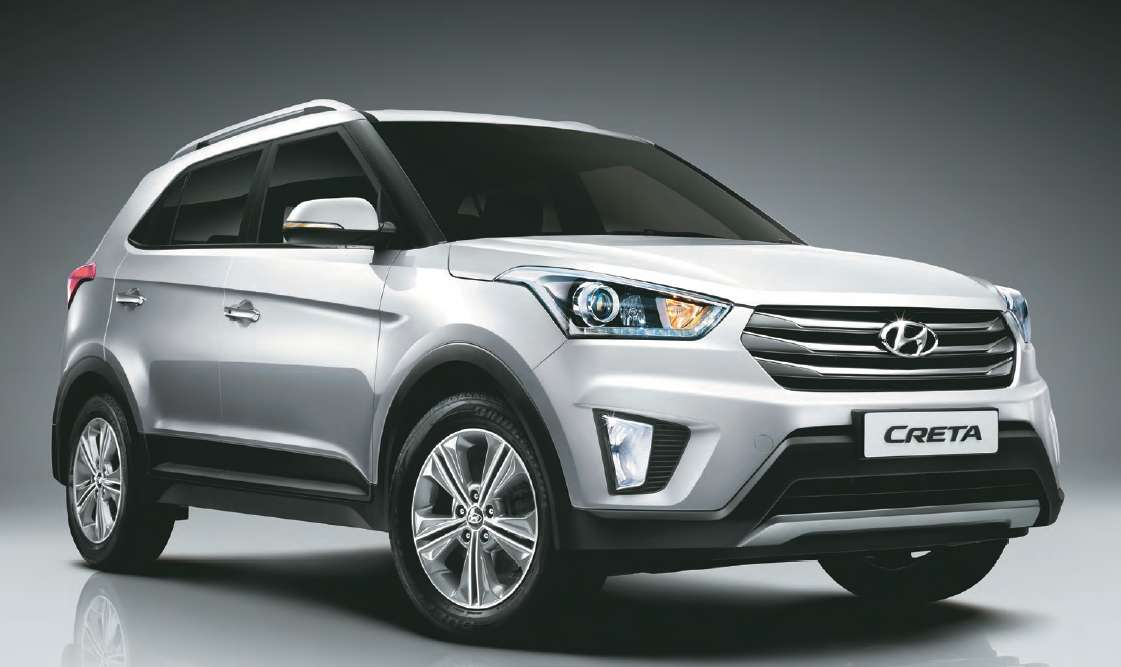
Indeed, the Creta’s appearance is eye-catching. Of course, it’s not as pretentious as the avant-garde look of its competitor, the Renault Kaptur, but the car still has a graceful stance. The Korean crossover’s exterior design continues the “flowing sculpture” concept that Hyundai previously used on other models. The crossover’s appearance is more classic, with smooth curves interspersed with straight lines and angles. Despite its compact size, it visually even resembles a smaller version of the Hyundai Santa Fe—the same chiseled grille gleaming with chrome, wide hood and arches, and wedge-shaped headlights adorned with a scattering of LEDs. The Koreans, like all Asians, have taken into account one characteristic of the Russian people: they want a beautiful design that matches more expensive models. The Creta achieves this objective brilliantly. Furthermore, various accessories, such as side skirts, are also available as options.


Inside
The Creta’s interior is harmonious, moderately strict and at the same time has its own original style, the hand of European designer Peter Schreyer is felt. The interior architecture is original, but at times reminiscent of Solaris. However, the materials themselves, as befits a budget car, are of very mediocre quality. There is even a semblance of leather upholstery, although where would leather be here – the covering in the budget class is made of leatherette. Although the pseudo-leather is pleasant to the touch, the seats even have perforations. However, sitting in the driver’s seat is comfortable, and visibility is good. In the center is a screen of the multimedia system. It’s not very large, and looking at it takes your eyes off the road, but a multi-function steering wheel with buttons makes control more convenient. Incidentally, a navigation system isn’t available yet, even in the top-of-the-line version; it’s promised a bit later.
In front of the gearshift lever are buttons for heated front seats, a heated steering wheel, hill descent control, and the all-wheel drive differential lock. However, the gearshift knob itself isn’t even finished in leatherette, but entirely plastic. Additionally, heated rear seats, mirrors, fuel injectors, and glass are available for an additional fee. The base version, of course, won’t have all these bells and whistles.


On the Road
We’re testing the top-of-the-line Hyundai Creta with a two-liter gasoline engine, automatic transmission, and all-wheel drive. We decided to take this car out of town to drive it on country roads and kick up some dust on the dirt roads. However, on the highway, the car with the top-of-the-line engine handles quite confidently and accelerates quite dynamically. The steering is quite light, and if you drive the car in the city, maneuvering in traffic is a pleasure. As we accelerate, the steering becomes heavier, preventing the driver from making sudden movements.
So, about 20 minutes after leaving the dealership, we reach the vicinity of the Don-25 off-road highway. I carefully turn onto a dirt road, afraid of catching the optional fender sills, but everything is fine. The 190 mm ground clearance allows for the car to negotiate shallow ruts without fear. The car tackles inclines and descents boldly and courageously. The 150-horsepower engine has enough power to confidently race off-road at 90 kilometers per hour, raising clouds of dust in its wake.


But let’s throw the Creta a more serious challenge in the form of a steep descent and ascent. We drive up a huge hill with a small cliff behind. At first, the height takes a slight fear. All I see in front of me is the sky. Now I wish there was a transparent hood so I could see what’s down there. Activating the hill descent control system, I begin to move forward practically by touch. The Creta slowly begins to descend, I feel the rear left wheel hanging out, and the car begins to scrape those very same Fildeppers sills along the ground. I’m starting to worry about the wisdom of such a trip, lest I get stuck here for too long. But no, everything works out; the Creta slowly finds its way onto all four wheels, and I move forward. It doesn’t feel like a roller coaster, but it’s close. The Creta handled it, of course, but I wouldn’t recommend anyone attempting to climb and then descend such a hill without proper training. Although the cars were specially adapted to our conditions, having clocked up around 370,000 kilometers in six months.
What’s the power, brother
Remember the famous line from the movie hero? And indeed – all power is in the money, or rather, in the price tags and trim levels. For this price, none of the competitors offer such a set of features as the Creta.

The Hyundai Creta is available in three trim levels: Start, Active and Comfort. The base version includes front airbags, ABS, stabilization system, power steering, tire pressure sensors, electric windows on all doors, a multimedia system with a 4.0-inch screen with USB and Bluetooth, and 16-inch wheels. Two engines are available as power units (1.6 l/123 hp and 2.0 l/150 hp), two six-speed gearboxes (manual and automatic) and two types of drive (front and all-wheel drive). The price of the new Hyundai Creta in Russia ranges from 749,900 to 1,149,900 rubles. Of course, for an absolute victory, a diesel engine would have to be added to the engine lineup, but unfortunately, it is not planned yet.