
“These Zhiguli… I don’t know what they’re thinking. They’re spinning, spinning, spinning underfoot…” – Ruben Khachikyan, from the film “Mimino”
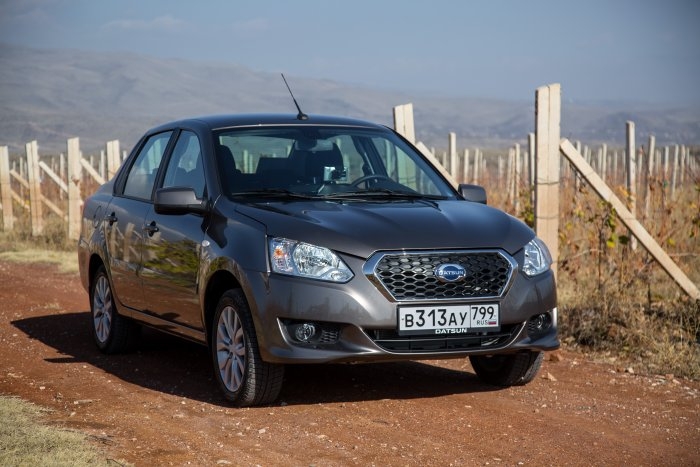
The famous line by Frunzik Mkrtchyan, playing the Armenian driver Ruben Khachikyan in the film “Mimino,” characterized the products of the Volga Automobile Plant back in Soviet times. Forty years have passed since the release of the cult Soviet film, and specialists from Japan’s Nissan have taken on the task of redesigning the Zhiguli. Two VAZ models, the Lada Granta and Kalina, have been modified and sold under the revived Datsun brand—the On-DO sedan and the Mi-DO hatchback. In a sense, the Japanese have begun to correct the mistakes of Russian engineers. Initially, purely cosmetic modifications were made, and the On-DO and Mi-DO were sold with the same engine as the Kalina and Granta. Initially, the Datsun in Russia was equipped with the eight-valve VAZ-11186 engine producing 86 horsepower, which was also used in the VAZ “eight.” Now, Datsun has added another engine to its arsenal: the sixteen-valve VAZ-21127 (106 hp), familiar from the Lada Priora. I went to test the car with the new engine in Armenia, the hometown of that very Ruben Khachikyan, in sunny Dilijan, and at the same time find out what the Nissan engineers had “twisted” into it.

Engine
So, as mentioned earlier, both the Datsun sedan and hatchback received the 127th VAZ engine. However, the new heart was not simply transplanted, but significantly recalibrated. According to Datsun representatives, the engine was extensively refined to meet Nissan standards. Engineers changed the final drive ratio, shortening it from 3.7 to 3.9. Now the car accelerates more confidently, which is clearly noticeable on long asphalt stretches, but as for mountain serpentines, here, of course, the car has a hard time. In addition, the car has a manual transmission, and in my opinion, it has a very long clutch pedal travel. It takes some getting used to at first. The new sixteen-valve engine is only available with a manual transmission; there’s no word yet on an automatic transmission.

Datsun also claims a smoother start with the new engine, but subjectively, you’ll only feel it after driving a Datsun for hundreds of kilometers. Don’t expect mind-blowing performance from a car with the new engine; it’s clearly not designed for high-speed driving, and it rolls noticeably in corners. That’s probably why the related Granta is so fond of cutting its springs in the Caucasus. With the new engine, the Datsun sedan and hatchback have become slightly more dynamic and fuel-efficient, and the top speed has increased by 10 kilometers, to 184 km/h. Acceleration from 0 to 100 km/h is 10.5 seconds. The fan mode has also been changed – it starts earlier. Cruise control has been added to the cars. These aren’t really major changes – they merely improve the overall impression of the car. Nissan engineers simply took the Granta/Kalina, tweaked it a bit, tweaked it, and tightened it up, resulting in a decent car for the money.

What else has been improved
Of course, the main change in the car is the new engine, but Nissan engineers have also saved up a few small things that improve the impression of the car. The green backlight of the trip computer, like on the first mobile phones, has now been replaced by a moon-white light. It’s very pleasing to the eye when driving at night. Another improvement concerns soundproofing. They sealed the trunk opening and the rear doors with sound insulation. In other words, they did for the buyer what they would have had to do themselves when buying the same Granta. The windshield washer nozzles now feature a dual stream, and all trim levels now feature longer mudguards to protect the sills from sandblasting. The door seals have also been replaced to ensure the doors close on the first try.

However, many owners complain that the driver’s door opens too wide and has to be constantly caught to avoid hitting a neighbor in the parking lot. For now, the door stop has been left unchanged, but they promise to fix this issue over time. In general, Datsun representatives are increasingly trying to distance themselves from the VAZ donor car, positioning their car as a foreign-made car rather than a heavily modified domestic vehicle. However, the cost of these modifications for the end consumer is not that high. The difference between a car with the base engine and the 16-valve version is only 15,000 rubles. But the main competitors of Datsun naturally remain Granta and Kalina with a price difference of about 30 thousand rubles.