
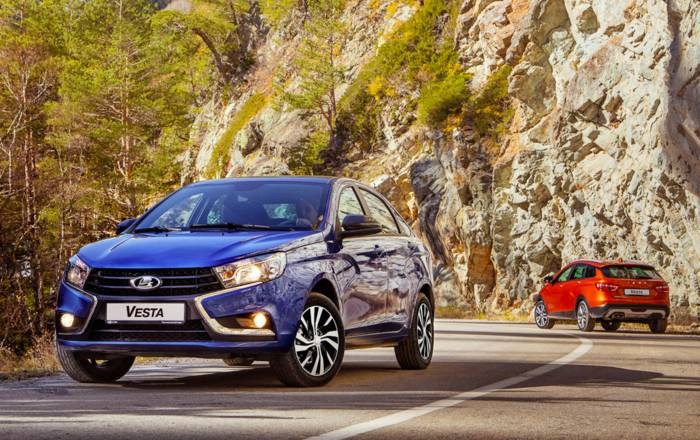
AVTOVAZ held a test drive of its Lada Vesta in Karachay-Cherkessia, featuring a 113-horsepower H4M gasoline engine and a Jatco CVT. This engine and gearbox combination is familiar from several popular Nissan and Renault models. Yuzhny Avtomobil test-drives the car to find out what’s new and how much it all costs.

After the Lada Vesta with a robotic gearbox was introduced three years ago, many buyers were disappointed with the car. The gearbox raised numerous questions, and actual owners complained of jerky transmission operation. After collecting negative reviews, VAZ engineers decided to work on the bugs and called on their colleagues from the Renault-Nissan alliance for assistance. They provided a practically ready-made solution for the Lada Vesta: the H4M gasoline engine, with a displacement of 1.6 liters and a power output of 113 hp, mated to a Japanese CVT from Jatco. This engine was first installed in the Nissan Note, and later appeared in the Nissan Juke and Qashqai. As for French Renault models, the same engine is installed in the Duster, Kaptur, Megane, Fluence, in the Logan/Sandero Stepway versions with a CVT, as well as in the base Arkana trim.

Most recently, the H4M engine with a Jatco CVT appeared in the Xray Cross hatchback, and now in all Vesta versions except the Sport trim. Many LADA fans expected that AVTOVAZ would bless them with a classic automatic, but this did not happen. There are several possible reasons for this. Firstly, AVTOVAZ itself doesn’t have its own ready-made solution. Secondly, its Nissan-Renault alliance colleagues are dictating their own terms, offering the H4M engine and Jatco CVT. Thirdly, the combination of a Japanese CVT and a French-Japanese engine significantly reduces the final cost of the car. Some wonder why Renault-Nissan doesn’t offer a classic automatic transmission and a different engine for the LADA? The answer is simple: all the automatic transmissions previously installed on Renault models are too old, and the engines they are paired with don’t meet environmental standards. This is where we got this solution—the H4M engine and Jatco CVT. Furthermore, the Vesta will no longer be equipped with the robotic transmission that initially displeased owners of the two-pedal Lada Vesta. From now on, if you want to buy a Vesta, it will be either with a manual or a Japanese CVT.

The engine and gearbox are the main technical changes that affected the Lada Vesta, but there are other design innovations. Due to the new engine mounts, the car does not have the rattling feeling in the front that was present in previous versions of the Vesta. For the new engine, Vesta has redesigned not only the engine mounts, but also the exhaust system. Another nice addition is the presence of disc brakes not only in the front, but also in the rear.

Changes in the interior and exterior
As mentioned earlier, the H4M engine and CVT are available for all trim levels except the small-scale Vesta Sport. The Vesta sedan or station wagon is available with a CVT, as well as the Lada Vesta Cross version with increased ground clearance. A new Exclusive trim level has been added, featuring a new wheel design wrapped in Matador R16 tires from Omsk. Cross models are equipped with Pirelli Cinturato tires on 17-inch wheels.

A fin-shaped antenna has been added to the roof. The Lada Vesta with a CVT is now equipped with new fog lights with a cornering function—when you turn the steering wheel left or right, one of the fog lights lights up depending on the selected direction. Frameless wiper blades are a rare sight these days, but they are now available on the Lada Vesta. Another new feature, previously unavailable on any VAZ model, is electric folding mirrors. This is a noticeable innovation in this class. This is the first VAZ with this feature in the entire history of LADA models. Two new colors are also available: blue and black. One is called “Diving,” the other “Maestro.”

As for interior innovations, they are relatively few, but they are there. In addition to heated rear and windshields, top-end versions feature heated front seats and a rear bench as well. The leather-trimmed multifunction steering wheel can also be heated. Exclusive versions feature a black fabric headliner, and the seats are a combination of fabric and eco-leather. The gearshift lever is similar to the Renault Fluence, with the selected PRND mode highlighted in large letters to the left.

In general, with the Vesta’s addition to the AVTOVAZ lineup, it’s safe to say there’s no longer any need to tweak anything in the garage. Everything has already been done at the factory. Top-of-the-line versions feature a rearview camera, cruise control, and a touchscreen multimedia system. Overall, if you’re not too picky, the top-of-the-line Vesta with a CVT will cost less than a million rubles and will have virtually everything you need for a modern car.

How it drives
During a test drive in the mountains of Karachay-Cherkessia, journalists were offered two versions of the new model: the Vesta sedan in the Exclusive trim level and the Vesta Cross SW station wagon. We had a chance to try both cars, but each has its own unique characteristics. From the first meters, it’s clear that the car starts off smoothly and without jerking. It doesn’t have the jerky rhythm that the robotic transmission had, which customers complained about.
In city driving, the transmission operation makes driving a pleasure. Cruising from traffic lights to traffic lights is quite pleasant, but if you need to accelerate sharply somewhere, for example, to quickly jump from a secondary road to a main one, you have to press the gas pedal thoroughly.

On the highway, when overtaking, you also have to work the gas pedal, and the car starts to roar slightly, but overall it’s not particularly critical. After a while, you start to get used to it. In terms of dynamics, the Vesta with a CVT has become faster. The sedan accelerates from 0 to 100 km / h in 11.3 seconds. The car with the robotic transmission needed 14.1 seconds. In terms of dynamics, there is a huge gap between the robotic transmission and the CVT.

It feels like the sedan drives more interestingly on mountain serpentines than the SW Cross station wagon. The latter is more laid-back and feels a bit bouncy in turns due to the car’s higher ground clearance and height.
According to the specifications, the station wagon is almost a second slower than the standard sedan when accelerating from 0 to 100 km (11.3 seconds for the sedan versus 12.2 for the Cross version). As for fuel consumption, the specifications show that in combined driving, the sedan averages 7.1 liters per 100 km, while the station wagon averages 7.4 liters. In active driving conditions in the city, on the highway, and on mountain roads, the actual average fuel consumption was slightly over 11 liters. Both cars left a positive impression, considering what we were offered for the stated price of up to one million rubles.

How much does it all cost
If we are talking about buying a new car, then the Vesta with a CVT for up to one million rubles is one of the best offers on the market and the most affordable in its class. In terms of equipment and driving characteristics, the Vesta with a CVT can easily compete with the German-Czech pair VW Polo / Skoda Rapid or the Korean duet Hyundai Solaris / Kia Rio. At the same time, in terms of price, the Lada Vesta beats all four. The first production models will appear at dealers at the end of November. The minimum cost of the Vesta sedan with a CVT and air conditioning will cost 736,000 rubles for the sedan and 773,900 rubles for the station wagon. The most expensive Exclusive versions cost 924,000 and 961,900 rubles, respectively.

Thus, you can assemble a well-equipped new car for under a million rubles. The Vesta with a CVT is definitely better and more reliable than the Vesta with a robotic transmission. However, given the ingrained public perception of the unreliability of all CVTs, it will certainly hinder the car’s sales initially. Using the Xray Cross model as an example, VAZ employees claim that sales of cars with CVTs have increased, so the Russian Vesta has a real chance of displacing the Koreans. Although, calling the Lada Vesta a purely Russian car is only partially true. Lada started its journey in the 1970s with foreign technologies, and in the 2020s, it returned to them again.
Source: