
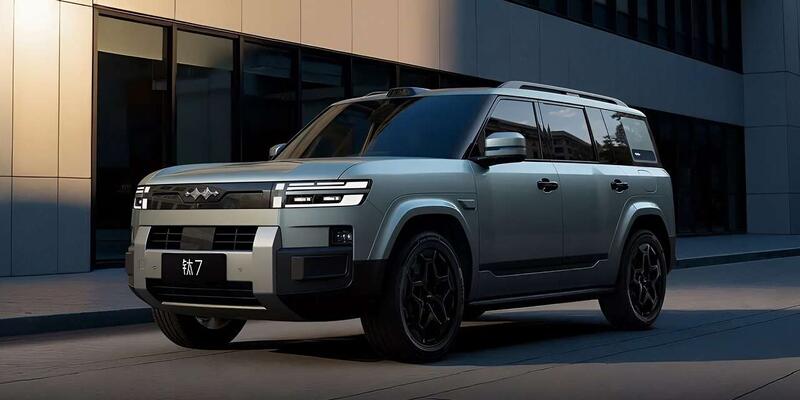
Sales of the new BYD FangChengBao Titanium 7 frame SUV, dubbed the Chinese equivalent of the Land Rover Defender, have begun in Russia. Prices start at 5.4 million rubles. The hybrid system produces up to 490 hp, and the car has a range of up to 180 km on electric power.
One of the most talked-about Chinese SUVs of 2025, the BYD FangChengBao Titanium 7, is now available for purchase in Moscow. Prices at dealerships range from 5.4 to 5.95 million rubles. The vehicle is positioned as a direct competitor to modern Defender-like SUVs: large, technologically advanced, and designed for tough operating conditions.
The vehicle’s design is executed in a “military premium” style: a combined khaki/black body, massive bumpers, a protective body kit, and 20-inch wheels. The dimensions are impressive: length – 4,999 mm, width – 1,995 mm, base – 2,920 mm. This is comparable to the Land Rover Defender 110, but with a distinctive Chinese technological accent.
Under the hood is a hybrid system with a capacity of 490 hp, the top speed is limited to 190 km/h. On electric traction, the vehicle can travel up to 180 km, which makes it one of the long-range EREV SUVs on the market. All-wheel drive, continuously variable transmission.
The interior is finished in milky leather and resembles a premium interior. The dashboard is equipped with five screens: a 12.3-inch instrument panel, a 15.6-inch central display, and a huge 26-inch projection. Two 13-inch tablets are provided for rear passengers. There is a panoramic roof, three-zone climate control, massage and ventilation of seats, memory positions, wireless charging, a 4.5-liter cooler box, and an audio system with 20 speakers.
The safety features correspond to the flagship level of BYD: lidar, blind spot monitoring, lane keeping, adaptive cruise control, all-round cameras, road sign recognition, and driver fatigue assistant. Among the unusual solutions is a suspension that automatically compresses the wheel when the pressure drops.
In China, Titanium 7 costs from 179,800 yuan (about 2.1 million rubles). In Russia, taking into account logistics and recycling fees, a price of 5.4 million rubles looks expected for the parallel import segment.