
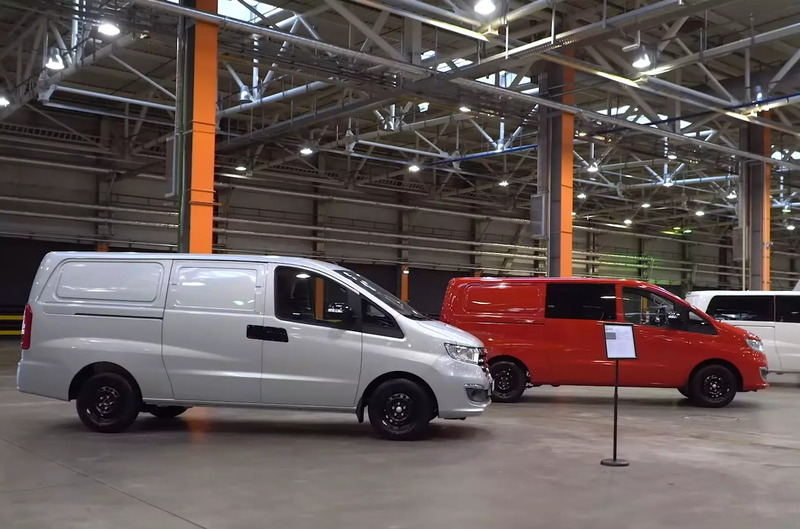
Buyers looking for a roomy family vehicle typically consider large crossovers or minivans. However, these classes have different advantages: the former attract with ground clearance and versatility, while the latter offer more space and a comfortable passenger layout. The Russian Sollers SF1 is trying to appeal to the latter category of buyers.
The model is manufactured in Tatarstan at the Sollers Alabuga plant. With a body length of 5.1 meters, the car offers seven seats and a spacious trunk. In terms of price, it is comparable to the most affordable Chinese crossovers, so it has the potential to become an alternative to traditional family SUVs.
Za Rulem magazine tested the minivan. The results showed that the car has significant practical advantages, but also revealed features that could influence the purchasing decision.
Seven-seat layout against the fashion for crossovers
The Sollers SF1 is interesting above all for its dimensions. The car reaches 5115 mm in length, and the interior provides seven seats. This format allows it to be considered not only as a family vehicle, but also as a car for corporate transportation, small travel companies and other purposes where capacity is important.
Unlike most compact crossovers, the third row here is part of the basic concept of the car. The buyer chooses a car not for its external resemblance to an SUV, but for the ability to transport several passengers at once.
However, the SF1 has a significant limitation that Russian motorists should take into account. The ground clearance is only 130 mm.
This means that the minivan is not well suited for regular trips on bumpy roads, deep ruts and snow-covered yards. Even an ordinary high speed bump or an unsuccessfully located curb may require increased attention from the driver.
Thus, the external dimensions of the SF1 should not be misleading: we have before us a roomy passenger car with a primarily urban purpose, and not a universal vehicle for all road conditions.
1.5 engine with 136 hp: unexpectedly high-torque, but does not like high revs
The power plant of the minivan is represented by a 1.5-liter gasoline turbo engine. Its capacity is 136 hp. sec., and fuel is delivered via multipoint injection.
According to Kirill Mileshkin’s tests for the publication “Behind the Wheel,” the engine has a rather unusual characteristic. At low revs, it demonstrates confident traction, which becomes available from approximately 1,500 rpm.
This behavior is reminiscent of diesel power units: for everyday driving, there is no need to constantly rev the engine. This is convenient in urban conditions, when the car often starts, slows down, and picks up speed again.
But the engine has a peculiarity: after 4,000 rpm, its activity noticeably decreases. Therefore, you can’t expect a sporty character from the 136-horsepower unit.
For a seven-seater, this is an important nuance. When fully loaded, the weight of the car increases, and the requirements for dynamics become higher. The driver will have to take into account the engine’s characteristics when overtaking and merging onto highways.
Why a five-speed gearbox raises questions
A five-speed manual transmission works in tandem with the turbocharged engine. The number of gears was one of the criticisms raised during testing.
For a large minivan, a sixth gear could make driving on the highway more comfortable. At high speeds, an additional gear would allow for a more suitable engine operating mode.
This is especially relevant for buyers who plan to use the car for family trips between cities. During long-distance driving on the highway, not only dynamics and stability are important, but also noise levels and fuel efficiency.
However, evaluating a transmission solely by the number of gears would be wrong. To fully understand its capabilities, it is necessary to take into account the gear ratios, engine settings and real-world operating conditions.
Crosswind and ruts: handling features of the Sollers SF1
The tester had more serious questions about the car’s behavior on the road.
Due to the relatively narrow track, the Sollers SF1 is sensitive to crosswind gusts. When exposed to them, the minivan may deviate from its original trajectory.
It is especially important that the car’s reaction is also noticeable when driving on roads with pronounced ruts. Uneven surfaces and uneven surfaces can additionally affect the direction of movement.
According to the expert’s observations, the dependent rear axle is the first to react to such effects. This is a design feature that the driver must take into account when driving on the highway.
The stabilization system also does not always go unnoticed. Electronics may interfere with control even when the rear driving wheels pass over plastic road markings.
For a potential owner, this means that before purchasing, it is advisable to evaluate the car’s behavior not only on smooth city asphalt, but also on country roads.
Leaf spring suspension: reliability and comfort don’t always go together
Another feature of the SF1 is related to the rear suspension. The design uses leaf springs, which is typical for vehicles designed to transport cargo and operate under load.
When fully loaded, the minivan becomes more predictable on the road. However, passenger comfort remains a debatable issue.
On large uneven surfaces, the rear of the car exhibits pronounced vertical rocking. This is especially noticeable in the second and third rows of seats.
It turns out to be a kind of compromise: the suspension design is focused on practicality and load-bearing capacity, but does not provide the level of ride smoothness that buyers might expect from a family minivan.
When choosing a car for regularly transporting children and adults, it is advisable to check this point in person. A short test drive on smooth asphalt is not enough for such an assessment.
More than 10 liters per 100 km and noise at speed: how much does roominess cost
Operating costs are another factor that may affect the attractiveness of Sollers SF1.
During testing, fuel consumption exceeded 10 liters per 100 km. For a large seven-seater with a gasoline turbo engine, this result must be taken into account when planning a family budget.
If the car is used daily, fuel costs can be a significant expense, especially if we are talking about regular trips with a full load.
Acoustic comfort was also less than ideal. According to a Za Rulem expert, the minivan’s sound insulation does not meet the standards of modern passenger cars.
At speeds of around 110 km/h, the noise becomes so pronounced that further acceleration is no longer appealing. This is a particularly sensitive drawback for family transport: long trips require a quiet acoustic environment, especially when there are children in the cabin.
Who is the Russian Sollers SF1 suitable for?
Based on the test results, it becomes clear that the Sollers SF1 cannot be judged solely by the number of seats and the size of the body.
The model has an obvious advantage over many available crossovers: seven seats and a large interior volume. For families who regularly have to transport a large number of passengers, this is a weighty argument.
But the car requires the owner to be ready to put up with a number of compromises:
- clearance of 130 mm limits the ability to drive on bad roads;
- five-speed manual is not optimal for high-speed highway trips;
- crosswind and road ruts affect directional stability;
- stiff rear suspension reduces passenger comfort;
- sound insulation leaves much to be desired;
- fuel consumption in tests exceeded 10 liters per 100 km.
There is one more important One point: comparing the SF1 with Chinese crossovers solely on price isn’t entirely accurate. These are vehicles of different classes, designed for different use cases. A crossover may be more comfortable on poor roads, while a minivan wins in terms of seating capacity and passenger capacity.
Conclusion: The Sollers SF1 is a niche offering for those who truly need a seven-seater. Its strengths lie in its spaciousness and practicality, while its weaknesses lie in its comfort, road performance, and fuel economy. Therefore, before buying, it is worth comparing not only the cost of the cars, but also the expected operating costs, travel conditions and the real needs of all passengers.