
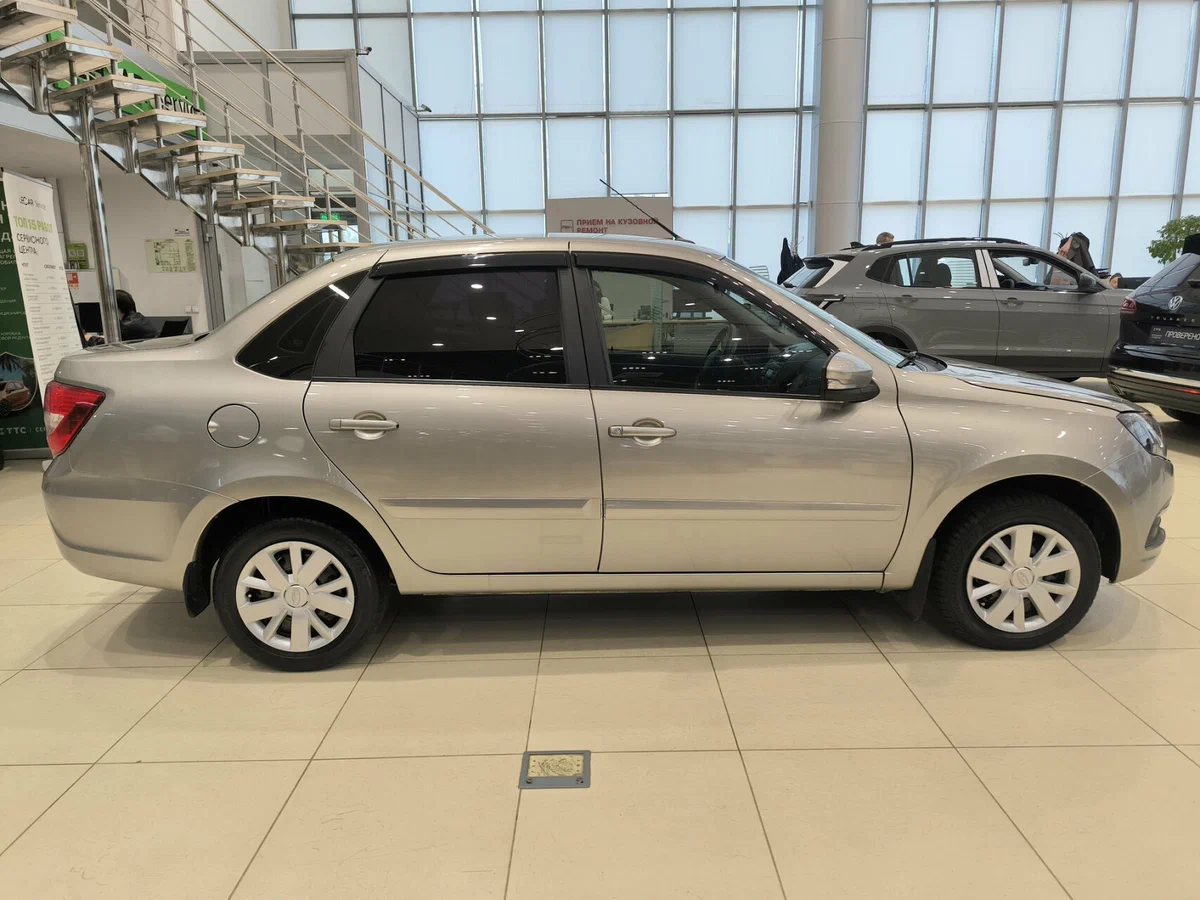
The Lada Granta has received a new modification with factory-installed gas equipment. This budget car can now run not only on gasoline, but also on propane-butane. This version can potentially reduce fuel costs over high mileage, but before purchasing, it is important to consider the initial cost of the car, the availability of gas stations, and maintenance features.
ATS Auto, AvtoVAZ’s official partner in the production of cars running on natural gas, announced the start of sales of the Lada Granta LPG. Unlike the previously presented gas modifications of Lada Vesta and Largus, which use methane, the new Granta is designed for a propane-butane mixture, which is more common in Russia.
How much does a gas Lada Granta cost?
The cost of the new modification requires further clarification: the published data includes two amounts – 1,133,000 and about 1.33 million rubles. Therefore, the final price should be checked with official dealers.
For comparison, a gasoline Lada Granta with a 90 hp engine is offered from 850,000 rubles. Thus, the difference between the regular and gas versions can be from several hundred thousand rubles, depending on the actual price of the LPG modification and equipment.
It is the initial overpayment that will be one of the main factors when choosing. Cheaper fuel in itself does not guarantee a benefit: to recoup the price difference, the car needs to travel a certain distance.
The full list of equipment of the gas Granta has not yet been disclosed. Without this data, it is impossible to reliably compare the cost of two versions with the same level of comfort and equipment.
How the Lada Granta LPG is designed
The gas Granta is equipped with a 1.6-liter gasoline engine with a capacity of 90 hp and a manual transmission. The car retains the standard gasoline fuel system, so the driver will be able to choose between two types of fuel.
The main features of the modification:
- 1.6-liter engine with a capacity of 90 hp. with.;
- manual transmission;
- petrol fuel system;
- gas cylinder with a capacity of 42 liters;
- cylinder placement in the spare wheel niche;
- filling port under the standard fuel tank flap.
The cylinder is installed in the spare wheel compartment, which eliminates the need to place a large container in the trunk. However, the buyer should clarify whether a full-size spare tire is provided, how the repair kit is stored, and whether the usable volume of the luggage compartment changes.
Another practical feature is the location of the filler port next to the petrol filler. The driver will not have to look for a separate place to fill the gas on the car body.
At the same time, the cylinder volume of 42 liters should not be directly considered as a gas reserve that can be used at each refueling: the actual amount of fuel filled depends on the system design and safety requirements.
What is the difference between propane-butane and methane
Previously, gas versions of Lada cars were produced with a CNG fuel system designed for compressed natural gas – methane. The new Granta LPG uses propane-butane, and this is a fundamental difference.
Methane is usually stored in cylinders under significantly higher pressure. Its placement requires the appropriate equipment, and the availability of filling stations may vary depending on the region.
Propane-butane is stored in a liquefied state under pressure. For the driver, this means a different type of gas cylinder equipment and the ability to use the infrastructure of gas filling stations offering automotive propane-butane.
Before purchasing, it is important to check how developed the network of gas filling stations is on common routes. For city trips and regular travel across the regions, conditions can differ significantly.
At the same time, LPG and CNG cannot be considered interchangeable systems: the equipment, cylinders and filling infrastructure are different.
Is it profitable to buy a Lada Granta on gas?
The main advantage of the propane-butane Granta is a potentially lower cost per kilometer. But the final savings depend on several variables: the price of gas in a particular region, fuel consumption, annual mileage, and the extra charge at purchase.
For a preliminary estimate, you can use a simple formula:
Savings per 100 km = cost of gasoline per 100 km − cost of gas per 100 km.
For example, if the conditional gasoline consumption is 8 liters per 100 km, and gasoline costs 65 rubles per liter, a trip of 100 km will cost 520 rubles.
If, for illustration, we take the consumption of propane-butane as 10 liters per 100 km and the price of gas as 30 rubles per liter, the costs will amount to 300 rubles. The difference will reach 220 rubles per 100 km.
This is a purely approximate calculation, and not the Granta LPG’s manufacturer-declared figures. Actual gas consumption should be clarified based on driving experience: it depends on equipment settings, route, vehicle load, and driving style.
With this approximate difference in consumption, savings over 20,000 km will amount to approximately 44,000 rubles. Therefore, if the gas version is 280,000 rubles more expensive than the petrol version, this extra cost will be recouped in fuel alone after approximately 127,000 km. The calculation does not take into account the cost of servicing the gas system and possible differences in configurations.
This example shows why the gas modification is primarily of interest to drivers with high annual mileage.
What you need to check before buying
Before placing an order, it is worth clarifying several important points with the dealer:
- the final price and composition of the configuration;
- warranty conditions for the engine and gas equipment;
- frequency of maintenance of the gas system;
- requirements for the inspection of the cylinder and its service life;
- the procedure for registering gas equipment, if applicable to specific modification;
- availability of service centers capable of servicing the LPG system.
It is also important to find out how the installation of the cylinder affects the ability to use the spare wheel and what restrictions are provided for the transportation of luggage.
Since gas equipment is related to systems that require compliance with special safety rules, you should not save on maintenance and checks.
Who is the gas Granta suitable for
The new Lada Granta LPG may be of interest to taxi drivers, corporate fleets, delivery services and private drivers who regularly cover long distances. For such buyers, even moderate savings per kilometer can compensate for the initial overpayment over time.
With a small annual mileage, the advantage is less obvious. If the car is used primarily for short trips around the city, the payback period may be too long.
The operating region is also important: the lack of convenient gas stations can minimize the practical benefits.
Bottom Line: The Lada Granta with propane-butane expands the choice of budget cars with alternative fuel systems. However, the model’s ultimate appeal will depend on the confirmed price, warranty conditions, and actual costs per kilometer. Until this data becomes available, it would be more correct to consider the gas Granta as a potentially profitable option for high mileage, rather than as an absolutely cheaper alternative to a gasoline car.