

The VAZ-2105 and VAZ-2107 are often considered virtually identical cars, but in fact, there are far more differences between them than it might seem. Let’s figure out how these models differ and why they continue to attract interest from car enthusiasts.
Even decades after their market release, the comparison of the “five” and “seven” remains relevant. These cars have long been a part of automotive history, but they are still seen on the roads and are actively discussed by both experienced and novice drivers. Against the backdrop of modern cars rich in electronics, classic models continue to attract with their simplicity, availability of spare parts and recognizable appearance.
The VAZ-2105 appeared in the late 1970s, and three years later AvtoVAZ introduced a more prestigious modification – the VAZ-2107. Both sedans were built on the Fiat 124 platform, but were positioned differently. The “Five” was conceived as a practical and affordable car, while the “Seven” was focused on increased comfort and status. Despite the common architecture, differences affected the design, equipment, technical characteristics, and even the approach to operation.
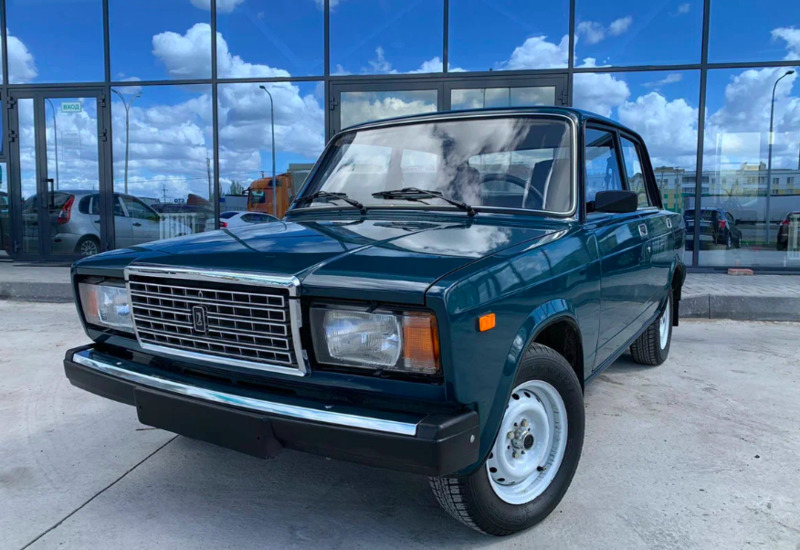
On the outside, the differences are noticeable primarily in the design of the front end. The VAZ-2105 received a simple black plastic radiator grille, while the VAZ-2107 was equipped with a chrome grille with vertical elements, emphasizing a more solid appearance. The hood of the “Seven” was slightly redesigned to accommodate the new shape of the grille and bumpers. Formally, the headlights of both models are the same, but the VAZ-2107 has added reflective elements, making the appearance more modern.
The bumpers are also different. The “five” has aluminum bumpers and is extremely simple, while the “seven” has plastic ones with chrome inserts. The first batches of these bumpers were purchased abroad and showed less than ideal reliability: cracks appeared in the cold, and their strength suffered. Production was later localized, but their reputation remained ambiguous.
At the rear, the differences are less obvious, but still present. The VAZ-2105’s taillights are divided into six sections, while the VAZ-2107’s are divided into five. The trunk lid of the “five” has characteristic indentations, while that of the “seven” is smoother. Overall, the rear of the VAZ-2107 looks neater, although to the uninitiated the difference may be almost imperceptible.
Inside the cabin, the contrast is more noticeable. The VAZ-2105 featured a simple instrument panel with two main gauges, while the VAZ-2107 featured a tachometer and oil pressure gauge—elements considered a sign of a higher class. Furthermore, the “seven” was equipped with central air vents, which significantly improved comfort in hot weather.
The VAZ-2107 had a factory-installed space for a radio, while VAZ-2105 owners often had to modify the panel themselves. The trim materials in the “seven” are softer, and the seats have more pronounced lateral support and anatomical shape. The seats in the “five” are firmer and simpler, which is especially noticeable on long trips. This is why many owners installed seats from the VAZ-2107, taking advantage of the high interchangeability of parts.
From a technical standpoint, the differences are also noticeable. The VAZ-2105 was most often equipped with a 1.3-liter engine producing 64 hp, while the VAZ-2107 received 1.5- and 1.6-liter engines with outputs up to 77 hp. The difference in performance is not significant, but the “seven” feels more confident when overtaking and driving on the highway. Both models were equipped with a five-speed manual transmission and rear-wheel drive, which ensured clear handling on the road but required certain skills, especially in winter conditions.
In the mid-2000s, both models received fuel-injected versions, but carburetor variants still predominate on the used market. This is explained by their simplicity and maintainability: a carburetor can be serviced without complex equipment, while an injector requires specialized diagnostics. For many owners, ease of maintenance remains a key advantage.
The VAZ-2105 weighs approximately 976 kg, while the VAZ-2107 weighs approximately 1060 kg. This difference is due to heavier seats, additional equipment, and reinforced body elements. The ground clearance of the “five” is 170 mm, while that of the “seven” is 175 mm, which can be significant when driving on poor roads. The trunk volume of both models is the same – 379 liters, and the fuel tank holds 39 liters, providing a range of approximately 450 km with average fuel consumption.
The speedometer scale remains an interesting detail: in the VAZ-2105 it is marked up to 160 km/h, while in the VAZ-2107 it is up to 180 km/h. Despite the cars’ actual capabilities being considerably more modest, such elements created a sense of dynamism and modernity, which was important to buyers of the time.
As a result, despite their outward similarities, the VAZ-2105 and VAZ-2107 represent two different approaches to the same platform. One focuses on maximum practicality, the other on comfort and prestige. Both models still find their fans, and their design remains a clear example of the Soviet engineering school, where even small differences mattered.