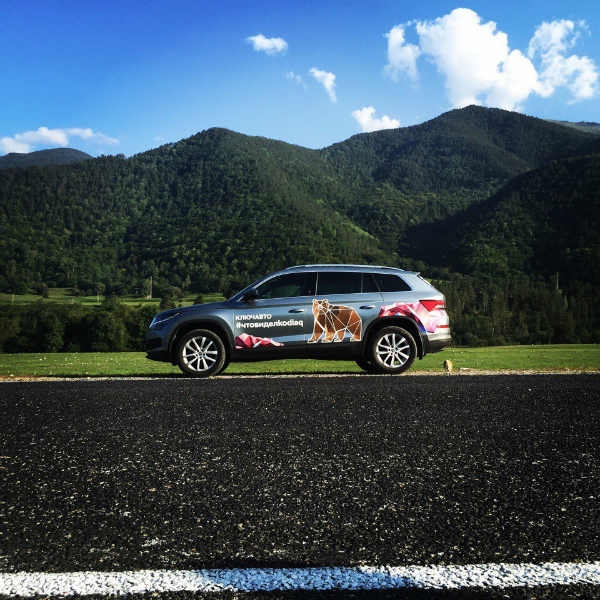
A few months will pass, and both amateur and professional skiers will flock to the mountains of Karachay-Cherkessia. Those who have never skied before should head there in early autumn. Yuzhny Avtomobil headed to the Karachay Mountains to test the Skoda Kodiaq crossover on the local roads and sample some Karachay khychins.
At a gas station with the strange name of YugTransNeftKavkaz, a Gazprom supplier, I insert the loose nozzle into the filler neck of my diesel Kodiaq. The pump starts buzzing and dispenses only three liters of diesel, even though I paid for twenty-five. After that, the fuel simply doesn’t flow from the hose. No, they don’t cheat in Karachay-Cherkessia. It’s just that most of the gas stations here are from Soviet times or even the 1990s, so their equipment leaves much to be desired. Seeing my surprised expression, the female operator comes to the rescue. It turns out I shouldn’t have forced the trigger of the fuel nozzle, just held it gently. A strange fellow, perhaps thought this Karachay woman, accustomed to seeing mostly parked Priora cars at the gas station.
Generally, everything in Karachay-Cherkessia lives to its own monotonous rhythm. People here aren’t used to drastic changes, so I look a bit of a foreigner here in my new Skoda Kodiaq crossover, even with Moscow license plates.

Onward to the mountains
However, despite the fact that my Kodiaq has Moscow license plates, I arrived in the Karachay-Cherkess Republic from Krasnodar, where our short trip began. So, having received the diesel-powered car from the Skoda dealership “Klyuchavto,” we, along with a group of bloggers and journalists, set off for Dombay. The distance from Krasnodar to Dombay is approximately 440 kilometers. At a leisurely pace, the journey will take about five hours, so you can take your time and enjoy the leisurely driving of the Skoda Kodiaq.

And again the bear
My first encounter with the Skoda Kodiaq happened about a year ago during the static presentation of the Czech brand’s first SUV at the plant in Mladá Boleslav. Back then, no one knew when Kodiaq sales would begin in Russia, what trim levels, engines, and, of course, the price would be. And now I’m driving a Czech-assembled Kodiaq along the roads of Kuban towards Karachay-Cherkessia. By the way, for those who don’t know, the Kodiaq is named after the bears that live in the mountains of Alaska, so we chose the right route.
From the first kilometers behind the wheel, I immediately notice the high seating position and excellent visibility of the Kodiaq. The car is well-built, the kind you’d usually hear described as well-tailored and tightly stitched. Skoda cars grow and progress every year, in some places even outgrowing their parent brand, Volkswagen.

During the presentation of the new Kodiaq last year, many journalists assumed it would be on par with the Volkswagen Tiguan, but the Czech car has taken a middle ground between the Tiguan and the Touareg.
In my opinion, the Kodiaq isn’t even a crossover, but a minivan with an off-road look, designed for long trips. A good driving position, a spacious interior, and a discreet 2.0 TDI diesel engine with 150 horsepower make the kilometers fly by.
There were four people in our crew, but we could easily have taken three more on board if we folded the rear row of optional seats. The interior ergonomics are designed around the driver and passenger, ensuring their comfort on long journeys. The car is packed with nice touches, including multiple USB ports, door umbrellas, and a removable light in the trunk. Simply Clever features found in other Skoda models have also appeared on the Kodiaq. The huge multimedia system screen is bright and glare-free; it reminded me of a tablet. The Kodiaq’s interior reminded me of a luxury Superb.

In some areas, Skoda has overdone it, and some Simply Clever features seem a bit odd to the average Russian. For example, the Kodiaq features a voice-enhancing feature for the driver and front passenger. A small microphone feeds their voices into the rear speakers, allowing second- and third-row passengers to better hear what’s going on up front. But, in fact, I wasn’t particularly pleased to hear my own voice coming from a pipe, and the Kodiaq’s sound insulation is decent; you can hear each other even without the sound system.

Driving Impressions
On a straight line, the Kodiaq holds the road confidently thanks to its weight and wide wheels, but in the mountains the car rolls a little if you get carried away with the speed. The two-liter diesel engine doesn’t drive us like a driver’s crossover, but like a large minivan – smoothly, measuredly, and even leisurely. Overall, the Kodiaq is a real bear.
In Drive mode, the car pulls in the mountains, but without much zeal. On short straights, overtaking trucks driving closely together is a bit difficult, but switching the seven-speed DSG gearbox to Sport mode corrects the situation. There is also manual transmission control. In my opinion, if you’re looking for a wild ride, get the Octavia RS wagon, but if you’re looking for a comfortable car for long trips, the Kodiaq is definitely for you.

The Kodiaq with its two-liter TSI gasoline engine is much more spirited than the diesel, producing 180 horsepower. Overall, I’ll say it again: the Kodiaq isn’t for “pushing corners” or racing at traffic lights; it’s designed for comfortable cruising.
This cruising can be not only comfortable, but also safe. A radar installed in the radiator grille constantly reminds you to keep your distance. There are also active safety systems; in addition to the traditional full complement of airbags, the Kodiaq also has seatbelt pretensioners. I was able to experience the latter’s operation while sitting in the passenger seat. When a fellow crew member slammed on the brakes, the belt literally instantly spurred me to the passenger seat.

Attracts attention
It’s pretty hard not to notice this car in traffic; its unusual appearance draws everyone’s attention. During stops, our Kodiaq was constantly approached by car owners inquiring about the car. Like many others, I would like to point out that if the Kodiaq were comparable in price to the Tiguan, it would sell like hotcakes, or at least like Karachay khychins.
Currently, the Kodiaq starts at 1.9 million rubles, and our car costs almost three million rubles—a bit pricey. Skoda’s Russian office promises that the car will become cheaper once Russian assembly begins, but for now, cars are imported from the Czech Republic. The first Russian Kodiaqs are expected to appear in April next year. They will be assembled at a plant in Nizhny Novgorod. More modest versions with a 1.4 TSI engine will be available. Then, the largest Skoda will be seen more often on Russian roads.

Summary
Overall, the car made a good impression, but the main drawback remains its price. Of course, I can’t say exactly how much the Kodiaq will cost after receiving Russian registration, but it is definitely more expensive than the Tiguan. Generally, the Kodiaq’s habitat is more city and highway. The Skoda crossover comes standard with a collision warning system that also detects pedestrians. Additional assistance features include a rearview camera and a blind spot sensor, which will warn you of oncoming vehicles when reversing. Even with its impressive dimensions, parking is easy (the Style trim offers good visibility and a suite of sensors), and the long wheelbase ensures road stability. Perhaps Skoda has decided to kill two birds with one stone with the new Kodiaq. Firstly, a large crossover has appeared in the lineup, and secondly, the new Kodiaq will be able to compensate for the lack of a minivan in the Czech Republic.