
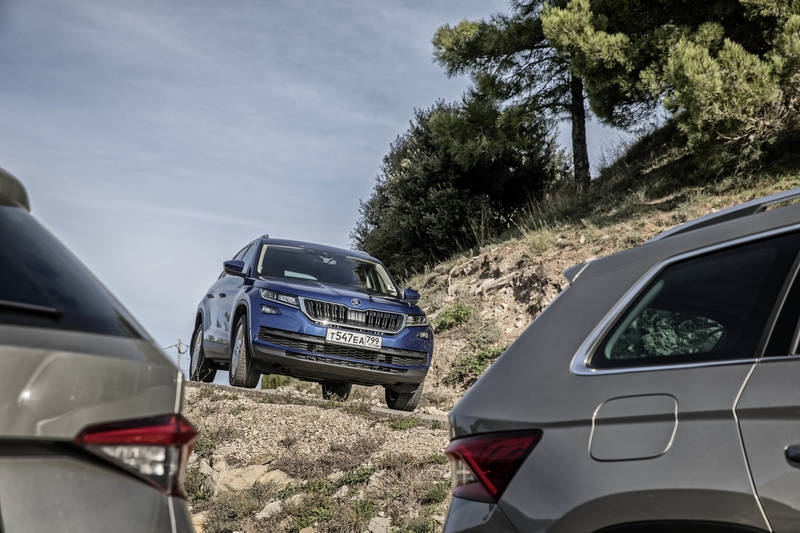
In 2018, the Kodiaq family crossover became one of the growth drivers for the Czech brand Skoda. After the first Kodiaq models rolled off the assembly line in Russia, it quickly became one of the top ten best-selling crossovers in the country. Yuzhny Avtomobil traveled to Barcelona to test-drive the brand’s bestseller on the Catalan roads.
Skoda Europe annually hosts the Skoda Driving Experience tour for regional journalists outside of Russia. This time, representatives of automotive publications were invited to Barcelona, where they were offered the opportunity to test-drive Russian-assembled Kodiaq crossovers in various trim levels. Yuzhny Avtomobil’s test drive included the top-of-the-line Style crossover with all-wheel drive and a 2.0-liter, 180-horsepower engine with a DSG7 robotic transmission. Incidentally, the cars assembled in Nizhny Novgorod are equipped with gasoline and diesel engines ranging from 1.4 to 2.0 liters and power outputs from 125 to 180 hp, paired with a 6-speed manual, 6-speed DSG, or 7-speed DSG transmission. There’s a choice to suit every taste and budget.

Our test drive started in a Barcelona suburb called Mas Salagros. We climbed into our vehicles and hit the road. From the first meters along the roads of Catalonia, you feel like you’re behind the wheel of a genuine European car, even though the crossover is assembled in Nizhny Novgorod. Stereotypes about Russian assembly being inferior to European ones are untrue. Cars undergo strict quality control at every stage of production, and the standards are absolutely the same for both the Czech Republic and Russia. The Kodiaq crossover is built on the MQB modular platform, the same one that underpins the popular Volkswagen Tiguan in our country.

Incidentally, after the Nizhny Novgorod-assembled Kodiaq appeared on the domestic market, those considering the Tiguan turned their attention to the Kodiaq. Essentially, the platform is the same, the engines are identical, but with the same specifications, the Kodiaq is larger and cheaper. Incidentally, you can also spot another Kodiaq sibling on Catalan roads: the Spanish Seat Ateca crossover. It’s very similar to the Kodiaq, especially in the design of its taillights. But Seat cars aren’t sold in our country, so in Russia, such a car is more of an exotica than a real competitor to the Czech Bear.

Our test drive took place in the picturesque surroundings of the famous resorts of Costa Brava and Lloret de Mar. Here, straight sections of road suddenly gave way to winding switchbacks, on which, of course, you wanted to floor the gas pedal, but you had to restrain yourself, fearing that some local Juan would dart out from around a blind corner in his old Seat. Incidentally, Catalans drive in a southern style—a bit sharply, but not exactly aggressively. However, they don’t always favor using their turn signals. As for mountain switchbacks, the Kodiaq handles confidently, but if you overdo the speed, you could end up flying off a cliff. The engine’s torque is sufficient for tackling long climbs, but tight corners aren’t the Kodiaq’s forte.

That’s especially true on high-speed toll roads, where the speed limit is 130 km/h. The crossover drives smoothly, and the sound insulation is excellent. My fellow driver and I didn’t even raise our voices during conversations; tire squeal and other noises barely penetrated the cabin. The two-liter Kodiaq accelerates from zero to 100 km/h in 8.2 seconds, and the top speed is limited to 207 km/h. While we certainly didn’t reach such speeds and followed the rules, one of our colleagues managed to reach 197 km/h, which didn’t exactly please the test drive organizers.

The engine is paired with a seven-speed DSG dual-clutch transmission. The gearbox shifts accurately, and we didn’t feel any discomfort on the mountain roads, thanks to the top-of-the-line 180-horsepower engine in our car, the Russian version’s top-of-the-line version. The 1.4 TSI engine with 125 horsepower will likely be a bit of a stretch for the crossover, but it will appeal to those who don’t like fast driving and would be happy to save on fuel.

Indeed, the Kodiaq isn’t a crossover for high-speed shootouts and traffic light races; it’s for a large family. We had a five-seater, but a seven-seat version is also available on the Russian market for larger families. This way, you can get an SUV with the functionality of a minivan. And all sorts of Simply Clever solutions make the car not only comfortable but also practical.

And by the way, many of the features here look like they belong in the premium segment. LED lights front and rear, leather-trimmed seats, a huge 8-inch multimedia system with voice control—all of this is just like the flagship Superb business sedan. There’s even adaptive cruise control. Another Simply Clever touch: umbrellas are hidden in special recesses in the front doors to keep you dry in rainy weather.

And here in Catalonia, the umbrellas came in handy. On the second day of our test drive, we were drenched by persistent rain almost the entire way, turning the roads of the Barcelona suburbs into full-flowing rivers. Here, not only the umbrellas but also the impressive ground clearance of 187 mm came in handy. By late afternoon, a heavy rain warning and an orange weather alert had been issued in Barcelona, but thanks to the Kodiaq’s excellent off-road capabilities, we managed to get it to the hotel without sinking.

As for pricing, the Russian-assembled Kodiaq with a 1.4 TSI engine, front-wheel drive, and a manual transmission starts at 1,413,000 rubles. By comparison, the related Tiguan with the same engine, transmission, and drivetrain costs 16,000 rubles more. Essentially, you get more car for less. As for the top-of-the-line Kodiaq Sportline, Scout, and Laurin & Klement versions, their price tags are already approaching three million rubles.

The high cost of the latter three is explained by the significant increase in customs clearance, as the top-of-the-line Kodiaq versions are imported from the Czech Republic. However, sales of imported Kodiaqs in Russia are minimal. Buyers mainly choose cars assembled in Nizhny Novgorod, due to the good price-quality ratio, as well as the rich level of basic equipment.