

The Great Car Price Inflation: +18% in 5 Years
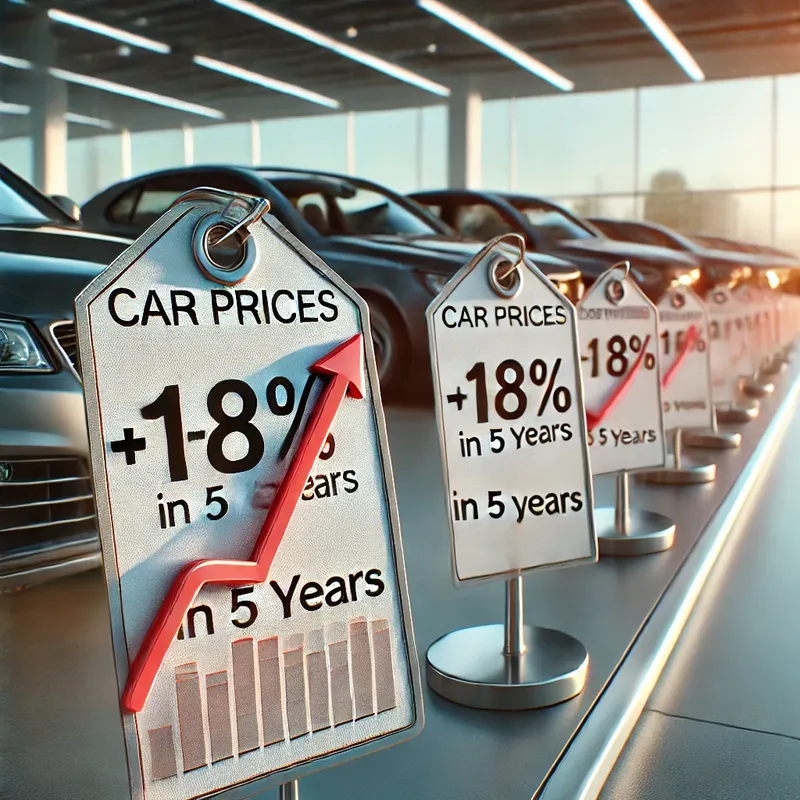
The Italian car market has seen a significant increase in the prices of new cars over the past five years, with an average increase of 18%. This phenomenon has raised concerns among consumers and industry professionals, leading to questions about the causes and possible consequences of this trend.
Analysis of price increases
To better understand the extent of this increase, it is useful to compare average new car prices in Italy with those in other European countries. The following table shows the average prices in 2019 and 2024 for internal combustion engine (ICE) vehicles and electric vehicles (EV) in different countries:
| Paese | ICE Price 2019 | ICE Price 2024 | ICE Change | EV Price 2019 | EV Price 2024 | BEV Variation | Italy
37.045 € |
43.871 € | + 18% | 49.080 € | 64.603 € | + 32% |
|---|---|---|---|---|---|---|
| France | €38,264 | €42,207 | + 10% | €59,197 | €55,430 | -6% | Germany | 42,120 € | 53,109 € | + 26% | 60,971 € | 64,146 € | + 5% | United Kingdom | 32,835 RUB | 42,493 RUB | + 29% | 51,035 RUB | 59,461 RUB | + 17% | Spain | 37,577 € | 44,243 € | + 18% | 62,035 € | 63.235 € | + 2% |

As can be seen from the table, Italy has recorded significant price increases for both internal combustion engine cars (+18%) and electric cars (+32%), the latter being higher than in other European markets. In particular, while in France the prices of electric cars fell by 6%, in Italy they increased significantly.
Factors contributing to price increases
Several factors contributed to the price increase: Rise in raw material pricesThe cost of raw materials such as steel and aluminum has increased significantly, which has a direct impact on the cost of producing vehicles.Transition to sustainable technologiesThe desire to create more environmentally friendly vehicles has led to investments in new technologies such as electric motors and driver assistance systems, which has led to an increase in production costs.Inflation and energy costsThe general increase in inflation and energy prices, aggravated by geopolitical Events such as the Russian invasion of Ukraine have further aggravated the situation, impacting production costs and, consequently, final prices of cars.
Consumer Impact
These price increases have had a significant impact on Italian consumers. For example, the average price of a new car rose from €17.360 in 2019 to €21.040 in 2019, an increase of 6.2%. This means that if in 2023 it took around 6.3 times the average net salary to buy a car, in 2023 it will take at least 7.7 times the average net salary.
Future Prospects
Forecasts for 2024 point to a gradual recovery in the global automotive market, with vehicle production expected to grow by 3%. In Italy, following an increase in registrations in 2023 (+19.3%), sales are expected to grow by around 2024% by 2024. However, the energy transition is proceeding slowly: in 2023, fully electric vehicles will account for only 4.2% of registrations, lower than in other European countries.
Conclusion
The rise in new car prices in Italy over the past five years is the result of a combination of economic, technological, and geopolitical factors. This trend has had a significant impact on consumers and the automotive market as a whole, calling into question the future of mobility and the sustainability of the sector.