

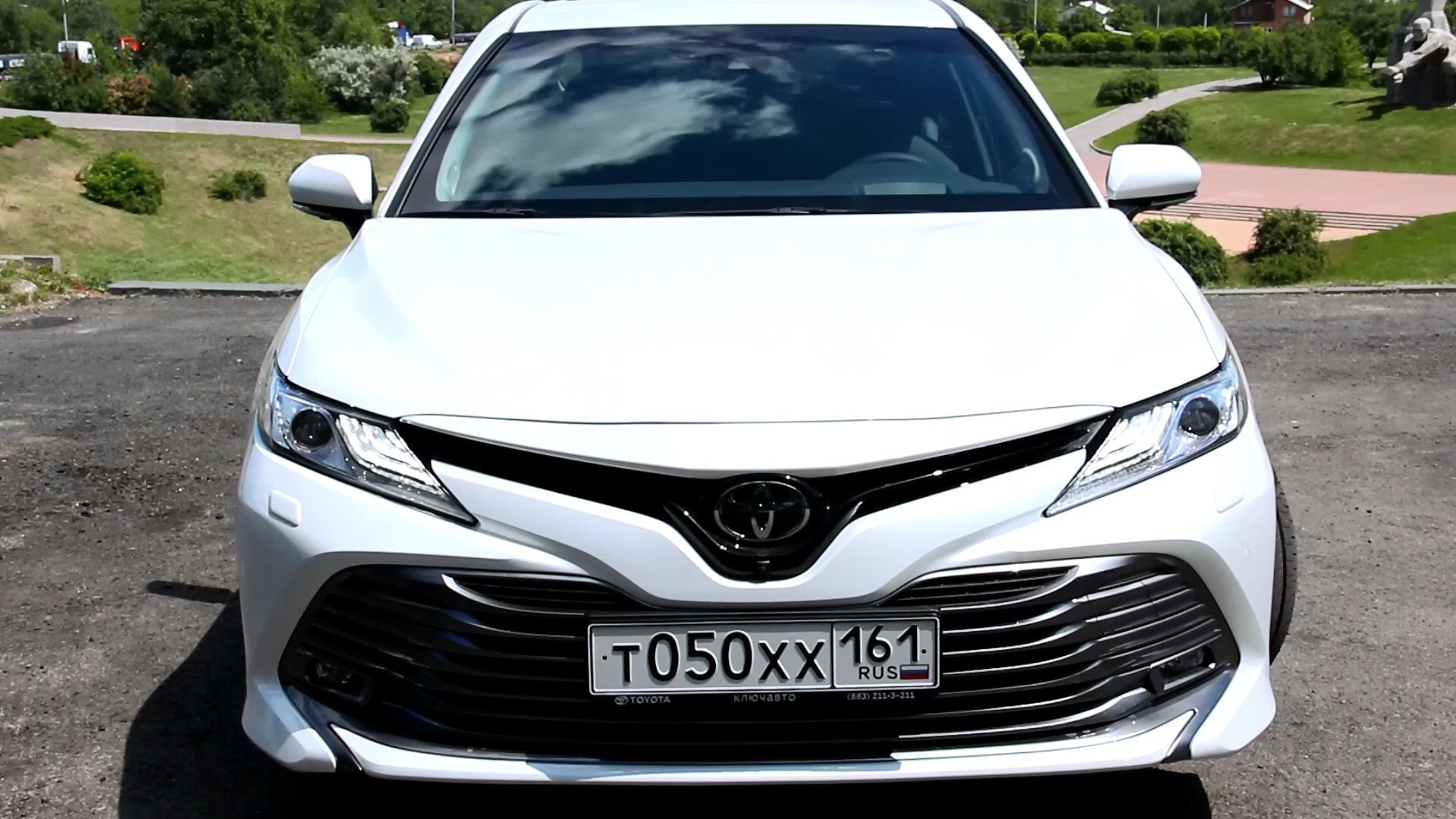
If you recall the days of the Soviet Union, the cherished dream of most citizens was to buy a new Volga, while others dreamed of advancing in their careers, becoming the head of a company or factory, and getting their hands on that executive Volga for official use. In modern Russia, the Toyota Camry has replaced the executive Volga, and there are already queues at showrooms for the new generation.
The Toyota Camry sedan is very popular in Russia, especially in the provinces, where it serves in various departments and ministries, transporting deputies of regional legislative assemblies, district heads, and mayors of small towns. In the capital, the Toyota Camry can increasingly be seen in corporate fleets or with business taxi services. Large, comfortable, reliable, and easy to maintain—all these qualities place it at the top of the Russian business-class car segment. Having appeared in Russia in 2002, about 350,000 Toyota Camry units have been sold in 15 years. Who hasn’t tried to unseat the Camry. The German Volkswagen Passat failed, the Koreans with the Hyundai Sonata failed, and sales of the Japanese business sedan Nissan Teana in Russia were several times smaller than those of the Toyota Camry. Each new generation of Camry is awaited with special trepidation in Russia, and the new generation XV70 was also awaited, although it arrived in our country six months later than in America.

It’s completely new
The Camry sedan in the XV70 body is completely new, it is built on a completely different TNGA platform, which Toyota engineers are currently implementing. The new generation Prius has already been built on the TNGA platform, and a new generation of the RAV4 crossover is expected in the near future. The new Camry is 35 mm longer (4,885 mm), 15 mm wider (1,840 mm), and 25 mm lower (1,455 mm), with a 50 mm longer wheelbase (2,825 mm). The design features more high-strength steel, with numerous reinforcements front and rear, increasing torsional rigidity by 30%. At the rear, the previous MacPherson strut has been replaced by a multi-link setup with separate springs and shock absorbers.

Toyota hints that the Camry is now designed not only for the rear passenger, but also for the driver. Compared to the previous generation, the new model has become more elegant and stylish, as evidenced by the narrow headlights. The headlights now feature LED low and high beams, and the narrow radiator grille with its emblem contrasts with the wide grille in the front bumper. Incidentally, the grille’s cells are quite large, so to protect the bumper from flying stones, you’ll need to install an additional protective mesh. Visually, the car is slightly flatter, and the sedan’s ground clearance is now 10 mm lower. Moreover, the base versions don’t come with underbody protection; it will have to be installed separately. Of course, the car looks better visually with large 18-inch wheels, which is exactly what we got for testing; the base Camry comes with 16-inch wheels.

Interior
Another advantage the Camry has always had over its competitors is its spacious interior. Although the extended wheelbase hasn’t made it even roomier, there’s still plenty of room inside. Traditionally, the Camry is designed around the rear passenger, so as before, there’s a huge bench seat with a fold-down armrest. In the top-of-the-line version, like ours, the armrest now houses touch controls for the radio, climate control, and heated seats. The panel is glossy, but fingerprints aren’t particularly visible. The previous generation had regular buttons instead of a touchpad in the armrest. It seems like a small change, replacing buttons with touchscreens, but it feels more expensive and luxurious. Two USB ports for charging mobile devices have also been added in the rear. There are no complaints about the new Camry’s cabin space. Incidentally, a central tunnel has now appeared in the rear. This is likely a future-proofing for the Camry, and we can expect it to receive all-wheel drive someday. But the central tunnel doesn’t restrict movement in the rear at all.

Well, now let’s move behind the wheel. The wide driver’s door allows for easy entry. Taller drivers will now find it easier to get comfortable behind the wheel. The steering wheel’s height adjustment range has increased by 20 millimeters, and the steering wheel has become smaller. Now, the steering wheel makes 2.5 turns from lock to lock, instead of 3 as in its predecessor. Another new feature is the move of the cruise control button from the steering column stalk to the steering wheel spoke, a European design. Those who prefer a low driving position will appreciate the Camry’s driver’s seat, which now offers noticeable lateral support.

The new Camry also gets rid of the American-style handbrake pedal. The parking brake is now a button on the center console between the driver and passenger seats. The tactile feel of the Camry’s trim materials has improved. All areas of tactile contact with the driver and passenger are hidden in leatherette and soft-touch plastic, and the steering wheel and gear selector are, of course, covered in leather. Our car had black leather upholstery, but a beige interior is available upon request.

The interior features fewer faux wood and faux aluminum inserts. The colors of these inserts are neutral, not the garish, bright colors that many people found off-putting when first looking at the interiors of previous-generation Toyota Camrys. The driver has easy-to-read instrument cluster gauges and a seven-inch TFT display. There’s also a projection screen. The center of the dashboard houses the multimedia system, framed in glossy black—it looks good, but the glossy finish begins to collect dust with use. The Toyota Touch 2 multimedia system interface is simple and straightforward, the menu layout is uncluttered, and it operates faster than in the previous generation. The car’s audio system is from JBL – 9 speakers, Clari-Fi technology, and FLAC support.

The car now has more electronics. Adaptive cruise control is now available with the ability to brake to a complete stop and then start moving – a very handy feature in traffic jams. There’s also a lane keeping assist system with automatic lane correction, wireless smartphone charging, and a 360-degree video view.
On the move
We’ll note right away that our test car had a V6 engine. The displacement remains 3.5 liters and the power is 249 horsepower. But this is the only new engine in the Camry lineup. New cylinder heads and a combined fuel injection system (both directly into the combustion chamber and into the intake manifold) have been added. The six-cylinder engine is paired with an eight-speed Aisin automatic transmission. It doesn’t lag, and the car drives quite dynamically, without even needing to switch to sport mode. The car has become more fuel-efficient; on average, consumption during our test was around 10-12 liters, although with the gas pedal fully depressed on the highway, instantaneous consumption was around 23 liters. As they say, performance comes at a price. Generally speaking, the Camry is not picky about fuel; the manufacturer even allows the use of 92-octane gasoline. According to the specifications, the new Camry with a 3.5-liter engine accelerates 0.6 seconds slower than its predecessor, but this should be adjusted for the increased weight. Although, purely by feel, the car is quite dynamic, and on the highway there is more than enough power to overtake two or three stretched-out trucks in one go.
In addition to the six-cylinder engine, two more four-cylinder ones are available – with a volume of 2 and 2.5 liters. These engines are familiar from the previous generation of Camry. These are old, reliable power units. The base version has a two-liter engine with a capacity of 150 horsepower. The power of the 2.5 engine is 181 horsepower. The difference is that the two-liter version works with the old six-speed automatic, and the 2.5 engine received an updated gearbox with a modified torque converter and a reprogrammed control unit.

Prices
In the standard configuration with a two-liter engine, prices for the new Camry start at 1,399,000 rubles. The base Camry comes with LED headlights for low and high beams, alloy wheels with 215/60 R16 tires, dual-zone climate control, heated front seats, and heated windshield wiper rest zones. The most expensive Camry trim, with a full complement of features including head-up displays, rearview cameras, steering wheel paddle shifters, and a 3.5-liter engine, costs over two million rubles. The Executive Safety trim starts at 2,341,000 rubles. The Elegance and Prestige trims with 2.5-liter engines will likely be the most popular. Their prices start at 1,818,000 rubles and 1,930,000 rubles, respectively. The key here is to determine what you want from a car.

If you need a comfortable, smooth, and unpretentious car with a spacious interior, you can go with a version with a two-liter engine, but you’ll have to sacrifice performance. Of course, if you spend a lot of time behind the wheel, a car with a 3.5-liter engine is simply excellent, both in terms of performance and comfort, but it’s a million rubles more expensive than a standard Camry. The optimal combination of performance and comfort, as mentioned earlier, is a sedans with a 2.5-liter engine.
Toyota Center Rostov-on-Don East
Rostov region, Aksai,
Aksaisky Avenue, 13
(M4-Don highway),
tel.: +7 (863) 210-70-70