

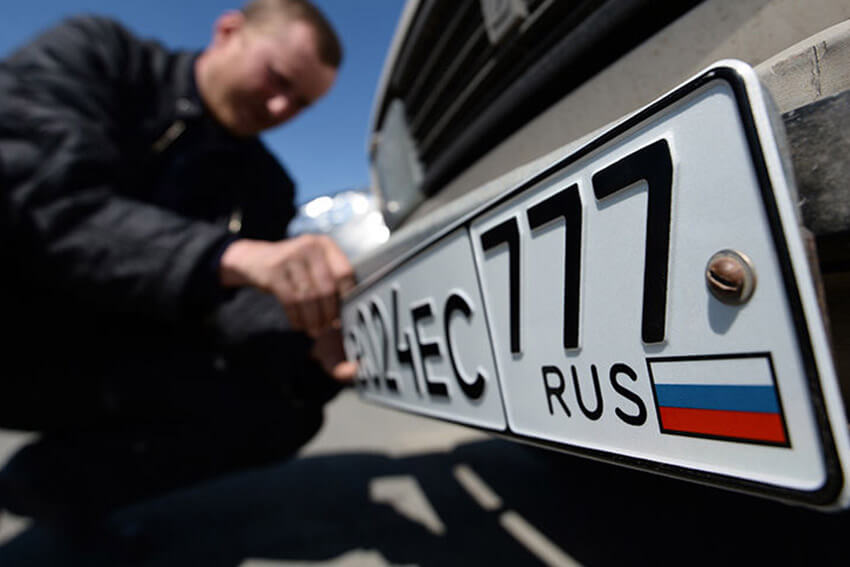
Russian drivers will start receiving new license plates as early as 2019. Motorcycle license plates will be one and a half times smaller in size, and plates for Japanese right-hand drive cars will be square in shape. It is planned to introduce special plates for mopeds, as well as for classic and sports cars. The corresponding GOST was approved by the order of Rosstandart and comes into force on January 1.
From January 1, 2019, in accordance with the order of Rosstandart 555-st, a new GOST “State Registration Plates of Vehicles” will be put into effect. The development of the document began in 2016 on the initiative of the Scientific Center for Road Safety of the Ministry of Internal Affairs of the Russian Federation.
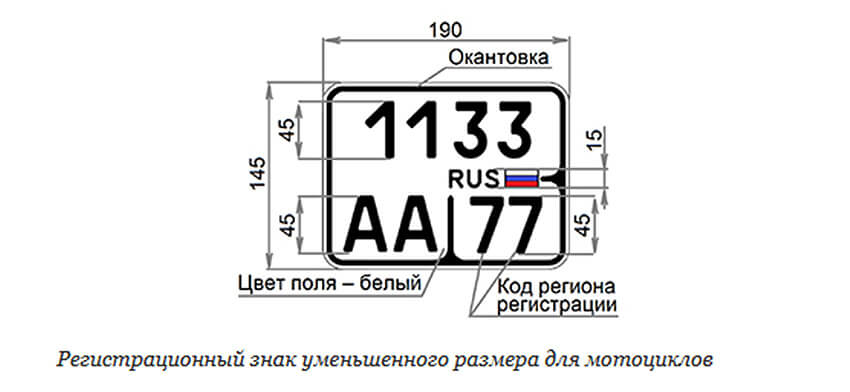
We were able to familiarize ourselves with the text of the document, which introduces ten new types of registration plates. Thus, reduced-size license plates will be available for motorcyclists: 190 by 145 mm (instead of the current 245 by 160 mm). Foreign motorcycles (there are an order of magnitude more of them than domestic ones) have a small area for the license plate — the Russian state sign simply does not fit on it. The old GOST of 1993 did not take this into account. Bikers have to use adapters, without them the wind can tear off the license plate at speed.
There will also be license plates designed for the rear platforms of Japanese and American cars with a non-standard mounting location. We are talking about cars imported to the Russian Federation in a “gray” manner, and not through dealers. In 2009, the import of such cars sharply decreased as a result of the introduction of prohibitive duties. Nevertheless, according to the Avtostat agency, the share of cars in the Russian Federation, for example, with right-hand drive is 8.2% (4.1 million vehicles). There is no exact data on the “Americans”. Many of these cars have a square rear platform, and car owners, like bikers, have to use homemade adapters or bend the standard rectangular number (its size is 520 by 112 mm). The size of the new state plates is 290 by 170 mm.

It is necessary to develop technical conditions for the application of GOST, explained Petr Shlyakhin, a member of the technical committee “Road Safety” at Rosstandart and deputy chairman of the classic car committee of the Russian Automobile Federation. “We need drawings with more precise parameters – for example, the distance between symbols,” he explained. “I am sure that the Ministry of Internal Affairs will develop them by January 1.” After that, the Ministry of Internal Affairs will begin purchasing new numbers from manufacturers through tenders. This is usually handled by a special police structure – the Special Purpose Center for Road Safety. A Kommersant source says that first, the old-style license plates need to be used up, which could take several months.
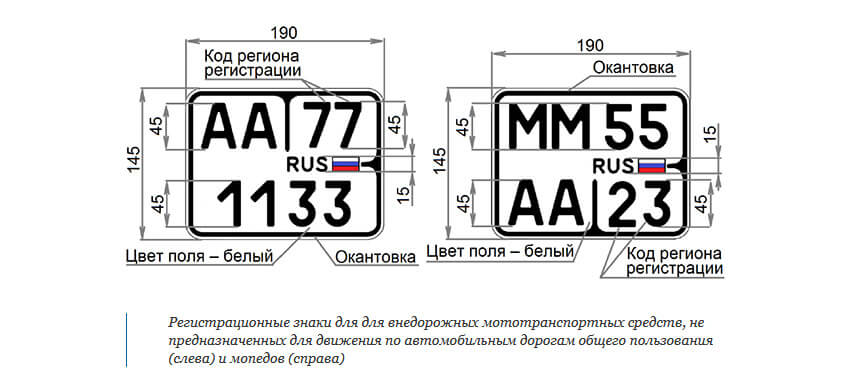
In the meantime, the standard introduces several more types of license plates. For the first time, special state license plates for mopeds will appear: they will be the same size as motorcycle license plates (190 by 145 mm), but with a different set of letters and numbers — ММ55АА77RUS (the structure of a motorcycle license plate, we recall, is 1133АА77RUS). The new type of license plate is intended for owners of so-called maxi-scooters: they are not full-fledged motorcycles, but are equipped with engines with a volume of more than 50 cc. The State Traffic Safety Inspectorate has no plans to register traditional mopeds and scooters (with small engines and a speed limit of 50 km/h) yet. However, there will be special motorcycle license plates on a red background for employees of foreign diplomatic missions, as well as plates for ATVs.
Retro and sports cars will also receive their own plates. Their main difference is the letters “K” and “C” separated from the other symbols by a line. For example, a plate for a classic 21-st “Volga” may look like this: K MM97677RUS; for a rally participant – C MM97677RUS. “Classics” and sports cars received not one, but three sizes of plates, – notes Petr Shlyakhin. – For example, owners of GAZ-69, “Moskvich” will be able to use the rear two-line plate for the “classics” in the space allocated for the Soviet plate.” The Russian Automobile Federation has long insisted on the introduction of such plates: they believe that in the future, special rules for the movement of such equipment are needed. For this, in turn, special registration rules are needed, explained Petr Shlyakhin.
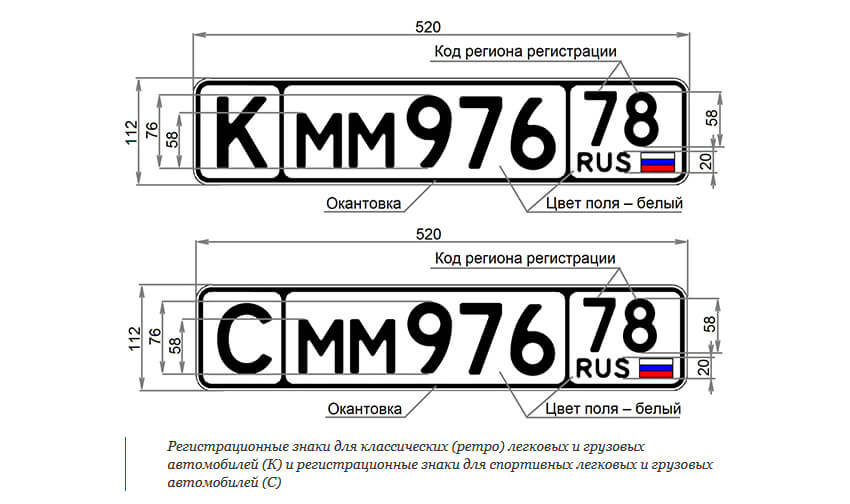
A number of innovations are, at first glance, of a technical nature. Thus, GOST stipulates that each number blank must have a unique 12-digit manufacturer’s code. It will tell the police where, by whom, when the state sign was produced and where it was sold. In addition, GOST lifted the ban on drilling additional holes in the sign: it only clarified that they should not affect the symbols, flag and RUS code.
During the development of the standard, experts suggested thinking about numbers for electric vehicles (with the letter “E”), bicycle numbers, and the use of new German fonts. But these ideas were abandoned for various reasons.
First Deputy Chairman of the State Duma Committee on State Construction Vyacheslav Lysakov supported the idea of special license plates for “Japanese” and “Americans”. “Despite the duties, the import of such cars continues, although in small quantities,” he says. “But we cannot ignore the needs of the owners of already purchased cars. We can’t drive around with bent license plates forever. This standard was needed a long time ago.”
Ilya Barsky, CEO of Simikon (manufacturer of Kordon road cameras), called the standard a reasonable idea. “We’ll just have to add new shapes to the list of those recognized by cameras, it’s not difficult,” he says. At the same time, he noted that there are no problems with recognizing bent license plates by cameras: “We have a significant number of devices in the Far East, and neither technical support nor customers have ever complained.” The company “Recognition Technologies” (the manufacturer of the “AvtoUragan” cameras) also noted that the systems recognize curved plates on the “Japanese” cars without any problems.
Video: New numbers will please owners of right-hand drive cars – Russia 24
Video: New state numbers of different sizes will appear in the Russian Federation – Izvestia
Source
,
WEBER-AUTO car service
194044, St. Petersburg
Neyshlotsky lane, house 5, building 3
District: Vyborgsky
Metro: Vyborgskaya – 800 m.
,
Seven days a week, from 9:00 to 21:00.
,
sto@veberauto.ru
,
8 (812) 321-00-00
Source:
veber-service
Source
,
WEBER-AUTO car service
194044, St. Petersburg
Neyshlotsky lane, house 5, building 3
District: Vyborgsky
Metro: Vyborgskaya – 800 m.
,
Seven days a week, from 9:00 to 21:00.
,
sto@veberauto.ru
,
8 (812) 321-00-00